Kaedrin.com
You are here: Kaedrin > Weblog > Archives > Weblogs

Weblogs
Wednesday, May 07, 2008

Sitemeter
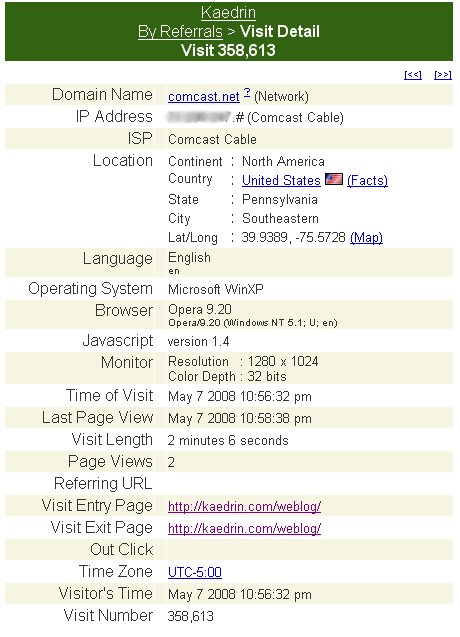
Via Steven's post on site tracking, I found out that Sitemeter was tracking rather more than it really should (use of spyware cookies and all that). This is a shame, as I really loved some things about Sitemeter, and none of the alternatives were able to approach the simple and useful reporting Sitemeter provided. I was particularly fond of their Visitor Detail page (note, that's a link to a screenshot, not Sitemeter), which contains a good summary of a visitor, where they came from, where they went on my site, and other standard info (OS, browser, location, etc...). They only tracked the last 100 visitors, but that was plenty good enough for me, and the service served me well for the past 9 years or so.

Still, they had frequent downtimes, and they've done very little to improve the service over the past 9 years, so I've always kept an eye open for alternatives. None of the popular services have ever really satisfied me though. Now comes this news of spyware, which is just a crappy situation, and so I've decided to remove all instances of Sitemeter from my site. This is most frustrating and I'm not happy with the situation. I've removed it from all blog pages as well as my main page. The rest of the site will have to wait a bit while I breath some life into my crappy, antiquated XSLT content management scheme (hopefully this will be completed by this weekend).

I've been playing around with Google Analytics for a bit, but they don't provide the kind of detail that I want for individual visits (though they're great for collecting general stats). I just installed StatCounter, which kinda, sorta has a page similar to the visit detail page from Sitemeter. But we'll have to see how that works out. I've heard good things about Mint, and I've heard that they have a plugin/extension/whatever-they-call-it that approximates Sitemeter's visit detail page. However, Mint actually costs money (imagine that!) and I don't want to pay for something that I'm not even sure will work for me.

Anyone know of another good stat package? Anyone actually use Mint? Again, what I'm really looking for is something that will provide details like this screenshot (perhaps with more details on what pages were actually visited (rather than just entry and exit pages)). [thanks to Robert for the link to details on the spyware cookies]

Update: StatCounter's visit detail page is pretty good, though you have to click through too many pages to get there.
Posted by Mark on May 07, 2008 at 11:38 PM .: Comments (0) | link | TrackBacks (0) :.


Technorati
According to Technorati, there are 112.8 million weblogs (as we'll see, this is probably a highly dubious number). I'm going to take a wild guess and say that the grand majority of them aren't very active. Even among active ones, I'm betting that most don't have much of a readership. Like this blog! Part of this is that blogs fall into a power law distribution, with a small set of bloggers getting the majority of the traffic. The rest of us are in the long tail, and it can be hard to find each other.

Enter Technorati, a service that seeks to track weblogs in numerous ways. You can go there and search on a subject to see what other blogs are saying about that subject. And if you're a blogger, you can see what other blogs are linking to you. They give each blog an "Authority" score which is based on how many people have linked to you (I think there's more to it than that, but I don't care enough to look into it that much), and then they rank all blogs by authority. To give you an idea of how this works, Kaedrin has an authority of 20. The top 10 blogs on Technorati have an authority of somewhere around 10,000 to 25,000.

Here's the problem: Technorati sucks. It definitely doesn't track all the blogs out there (not that big a deal, such a task is probably pretty tough), but it's definitely sure to pick up every new bottom-feeding spammer blog. In other words, every time I write a new post, it gets linked by two freshly minted spam blogs. Those show up fine. Meanwhile, a real blogger (who is listed on Technorati) links me, and Technorati doesn't pick that up (I find out by looking at my referrers). And the same thing happens when I link to other people. For some reason, Technorati decides some of my posts are not worthy of tracking. For instance, my last post isn't showing up in Technorati.

This happens every once in a while, and I think I've figured out why. It seems to happen when I post out of order. I generally post twice a week, but sometimes I start an entry early. Last week, I started writing my review of GitS:SAC on Tuesday. I hadn't finished by Wednesday, so I wrote and posted another entry while I finished off my review. On Sunday, I finished my review and posted it, but Technorati didn't pick it up (despite repeated pings and other attempts to allow the post to show up). Now, none of this shouldn't matter, but apparently Technorati thinks it does, because this exact situation has happened several times. Maybe it's because Movable Type numbers my posts, and if I post entries out of order, perhaps it confuses Technorati. For example, last week, I posted entry 1421 after I posted entry 1422. If this is why Technorati can't figure out that I posted something on Sunday, it's pretty damn stupid. It can't be that hard to fix this. Technorati claims that they track posts by scraping the page and also by using RSS feeds, but if that's the case, they must be doing something really dumb to get tripped up by postings showing up out of order.

So basically, Technorati doesn't track all the good weblogs, but it keeps up with all the spammers' weblogs. For some reason, it doesn't register a post that was written out of order either. So what's the point? I guess it works ok for bloggers who get lots of links. If you get a lot of links, the signal drowns out the noise of the spammers, and you don't miss the posts that Technorati doesn't pick up because you've got plenty of other links to go through. But for those of us on the long tail, it's nearly useless. It doesn't hurt anything, I suppose, so I'll continue to check every once in a while, but I'm not getting my hopes up. I don't think I've discovered any new blogs through Technorati that I hadn't discovered first from my referrers.
Posted by Mark on May 07, 2008 at 09:16 PM .: Comments (2) | link | TrackBacks (0) :.


End of This Day's Posts

Wednesday, September 19, 2007

Goblin Bloggin'
Since time is even shorter than usual, the Green Goblin is filling in with a video blog. Enjoy.

The project I'm working is almost over. It launches next week and I'm sure I'll be busy for a little while after that, but then we'll be back to blogging as normal.
Posted by Mark on September 19, 2007 at 11:10 PM .: Comments (0) | link | TrackBacks (0) :.


End of This Day's Posts

Sunday, August 19, 2007

Blogging Cliches
About a month ago, the Kaedrin Weblog reached the 7 year point. It's hard to believe that I've been blogging for so long, even though I perhaps don't write as many posts as your typical blogger. Every now and again, I like to take a step back and look at what I'm doing and where I'm going, and now seems like a good time for that. The last time I did this was back in January, and that's when i modified my posting schedule to post at least twice a week. So far, this has worked out reasonably well, though I will admit that my Wednesday entries tend to be somewhat lacking. This is due, in part, to an unexpected work schedule (which, come to think of it, should have been expected.) Honestly, I don't know how some bloggers do it.

In any case, via Steven, I came across Jeff Atwood's post about Thirteen Blog Clichés. Let's see how I'm doing:
  1. The Useless Calendar Widget: I've never had one, and to be honest, I never got why they existed in the first place. Indeed, the longer I blog, the more I realize that the standard date-based navigation of blogs leaves a lot to be desired (just look at the unwieldy list of monthly archives on my side nav). Maintaining a list of good categories (or using tagging) is a much better way of navigating through a blog. It's pretty rare that I ever even load a monthly archive page, and I never do so when I'm looking for a specific post (categories and search are much better for that). I must admit that my categorization scheme needs a lot of work, but it's still a much better way to navigate than dates.
  2. Random Images Arbitrarily Inserted In Text: Well, I don't do this, and to be honest, it's not something I've noticed very often, though I perhaps assume such images are simply advertisements and ignore them...
  3. No Information on the Author: While I do have an about page and an about me page, they're both outdated and could use some updating. Also, my name is on every post, so I think I'm covered.
  4. Excess Flair: I don't have much flair, though there are perhaps a couple of things. For instance, the image on the right navigation, which links back to some of my better old posts, would probably be considered flair, but I think it's a fair trade, as those posts would otherwise just sit, unread, in the archives. Not that I know whether or not people are clicking on it (and, uh, I haven't updated it in a long time), but still.
  5. The Giant Blogroll: I've kept my blogroll relatively small pretty much throughout my blogging history. This is perhaps due to the fact that I've never had that huge of an audience and was thus not forced to reciprocate via blogroll links, but even then, it's probably worth keeping the blogroll short (due to Inverse Network Effects, among other things)
  6. The Nebulous Tag Cloud: As previously mentioned, I think tagging is a much better way of organizing content for usable navigation than date-based archives, but I agree with Jeff that the trendy use of "Tag Clouds" is kinda silly and unusable. The other issue with tagging is that it can get a little ridiculous. For instance, look at the tag cloud for my del.icio.us bookmarks:

    The tag cloud for my del.icio.us bookmarks is absurd.

    That's not just useless because of the tag cloud, but becaues I have so many tags. One of these days, I'll create tag bundles which will make it a lot easier to navigate. Of course, there are other benefits to tagging on del.icio.us, notably the social networking aspects, but such benefits wouldn't be present on a blog. As such, I'm not sure I'll ever move to tagging for my blog (though I will probably start being a little more granular in my categories and sub-categories).
  7. Excessive Advertisements: I've never had any advertisements on this site, though I do link to Amazon with my Associates ID (which allows me to share a small but fun percentage of any sales made).
  8. This Ain't Your Diary: And indeed, this blog ain't my diary (though it would probably make posting every day a little easier, it would also probably be incredibly boring.)
  9. Sorry I Haven't Written in a While: One of the biggest obstacles I've faced in building an audience for this blog has been my low posting frequency. Ever since instituting my weekly schedule, I think this has gotten better, but even twice a week is perhaps too little to get people excited (or maybe it's my tastes). And to be honest, some of my Wednesday entries could probably be a little better.
  10. Blogging About Blogging: The ironic one, as both Jeff's post and mine are actually embracing this cliché, though Jeff sorta extends this to people who only blog about blogging, which is a little more understandeable. Personally, I kinda like reading about other bloggers' writing habits, but a blog which posted exclusively about blogging would indeed get old.
  11. Mindless Link Propagation: I'm guilty of this, particularly on some of my Wednesday posts when I'm short on time. I do try to make sure these links aren't posted all over the place before posting them, so perhaps those don't count, but even then I'm probably still guilty of this.
  12. Top (n) Lists: Aside from participating in the Friday is List Day meme, which isn't really what Jeff's talking about, I'm not sure I've ever written a top (n) list. It is kinda odd that such lists have come to dominate the social networking sites like Digg and del.icio.us popular, but it seems like this is a good way to create attention. I'm sure I'll write one at some point, but it won't be one of my standard blog conventions.
  13. No Comments Allowed: Jeff says A blog without comments is not a blog, but I disagree with that. In any case, I have comments. Jeff makes an exception for people with massively popular blogs, and Steven attests to that (as does Shamus). Personally, while I certainly wouldn't mind a little more traffic, I've written before about how I don't mind being a small blog. Jeff also notes that "the comments are often better than the original blog entry itself" which is something I've never found particularly true. Not that I don't appreciate comments, and indeed, the best comments tend to come on posts that only get 5-10 comments. Actually, comments on Kaedrin are actually pretty darn good, I think. So maybe he has a point. But on any post that has over 100 comments, it quickly gets absurd. Even if there's great content in there, it gets old fast.
All in all, I'm doing pretty well when it comes to these, though my blog still isn't all that popular.
Posted by Mark on August 19, 2007 at 01:22 PM .: Comments (2) | link | TrackBacks (0) :.


End of This Day's Posts

Sunday, April 08, 2007

Programming Notes
Two things I planned to write about this week (and in the coming weeks) have been delayed or otherwise cut short. First, due to some sort of Netflix screwup, I never got discs 2-4 of Vandread: Second Stage (disc 1 was great). Instead, I got 3 movies I wasn't expecting but want to see anyway (I still haven't figured out why, as the Vandread discs were next in my queue and they have a status of being available "Now"). With any luck, I'll have the rest of the series this week. This is the first time Netflix has ever messed up for me, so I guess I shouldn't complain, but still.

The second thing I was planning to write (a lot) about was the Philadelphia film festival. However, due to long hours and work and an otherwise hectic schedule, I doubt I'm going to get a chance to see the movies I wanted to. I might be able to make the trek to the city to see one or two films. Then again, I only saw 4 films last year (along with the Adult Swim thing), so I guess it won't be that much of a wash. Still, I had wanted to see more this year (and was even considering taking some time off), but the way certain projects have fallen at work, I just can't. There's always next year.

So blogging will be somewhat light in the coming week (I do still have another entry for tonight though). You never know, though. Sometimes my periods of highest blogging productivity are when I'm busiest in other areas of my life. Inspiration often seems to strike when you have the least amount of time to act on it. One of the ironies of life, I guess.
Posted by Mark on April 08, 2007 at 08:27 PM .: Comments (0) | link | TrackBacks (0) :.


End of This Day's Posts

Wednesday, March 28, 2007

Link to Someone New, Part 3
Time is short and it's been a while since I've done this, so here are three posts from blogs I've never linked before:
  • Domino Computation: A computer is basically a series of switches. Granted, they're very small switches, and there are millions of them in most computers, but the basic theory of the linked post is that you can do some computation using primitive means - in this case, dominoes. It's a pretty amazing post if you're interested in this sort of thing, and the author has lots of pictures and even videos of how he set up his domino calculator.
  • pdb Vs Matlock Jr.: pdb owns a video game and movie store and likes to make fun of his customers, as in the linked post which has a very Acts of Gord type feel to it..
  • Dreary Queen: This blog focuses on the corporate logo niche. In the linked post, they tackle Dairy Queen's new logo, which is very lame. "Dairy Queen's ellipse is one of the most highly recognizable marks, it is (was) unique, memorable and impactful. Despite this equity, Dairy Queen considered it was time to change and make the wrong moves in all the wrong places"
That's all for now.
Posted by Mark on March 28, 2007 at 08:35 PM .: Comments (3) | link | TrackBacks (0) :.


End of This Day's Posts

Thursday, February 22, 2007

Liveblogging on Sunday
A lot of people don't like to watch the Oscars anymore. For the most part, their reasons are sound: it's a long, boring, essentially meaningless awards show in which a bunch of self-congratulatory Hollywood insiders kiss each others arse (to put it nicely). Personally, I find that I'm able to deal with it mostly because I liveblog the event and usually get drunk. It's one of those rare occassions where a live event coincides with my blogging schedule, so I feel obligated to oblige. Anyway, I just wanted to let everyone know that I'll be updating all night on Sunday. Feel free to stop by and comment. I've been doing this for the past couple of years, and it's actually kinda fun. See previous installments here: 2006, 2005 and 2004. See you Sunday!
Posted by Mark on February 22, 2007 at 10:54 PM .: Comments (0) | link | TrackBacks (0) :.


End of This Day's Posts

Wednesday, February 07, 2007

Say Hello, Dammit!
I'm apparently about a month late to the party (what else is new?), but National De-lurking Week is a neat idea, so I figured I'd give it a shot. Like a lot of bloggers, most of what I write here is primarily for my own benefit. At the same time, it's always nice to know that someone is reading, and I wouldn't publish it on the internet if I was writing only for myself. However, one of the frustrating things about blogging is that it can be difficult to know who is reading. I have been lucky enough to have a small group of regular readers, most of whom comment regularly on the blog (thanks guys!). And I've picked up a few more regular readers over the years as well, though many of them tend to be lurkers - people who regularly visit, but don't comment.

This post is aimed at that second group of people. To be honest, I'm not even sure how many there are, but if happen to be a regular reader of this blog and haven't commented, please do so! As Sheryl puts it:
...I just read a Psychology Today article which notes a direct correlation between weight loss, and commenting on your favorite blogs, so leave a comment because it will make you skinny. Not that you're fat, because you're not!! So tell me how long you've been reading my blog, or your favorite book, or the first word that pops into your mind when you hear the word shish-kabob, and remember, if you don't leave a comment, you're letting the terrorists win.
And heck, if you're a regular commenter (or someone who doesn't comment often), feel free to comment about whatever you like. After all, I have a feeling there aren't going to be so many comments on this post, and I'd love to hear from everyone.

It's National De-lurking Week. Say Hello, Dammit!


Update 2.11.07: Well then, this was not so much of a success. This is mildly strange, as I can see from my referrer logs that there are people coming here that have not posted. Either they're not reading this post, or they're being rebellious. Strange. Thanks to all who commented, though:)
Posted by Mark on February 07, 2007 at 07:49 PM .: Comments (9) | link | TrackBacks (0) :.


End of This Day's Posts

Sunday, February 04, 2007

Link to Someone New
Once again, time has run short (big game* stuff), so I'll simply resort to throwing a few links at you under the pretense that I'm fighting the closed loop of blogreading that many fall into (previous installment here). So here:
  • Pointless Attack of a Random Person from Wikipedia: A humorous and exceedingly random blog really gives it to Paul LaFarge. Who the hell is that? Go and read.
  • Fantastic Films?: Kelson gives a brief preview of some movies to look forward to, including an adaptation of Neil Gaiman's Stardust (a film I didn't even know was being made - I must be slipping in my old age). This blog is also notable (to me, at least), because the author uses Opera. Awesome.
  • The Wii Sports Experiment: This guy bought a Wii and lost 9 pounds in six weeks from the exertion. The only change he made to his daily routine was to play 30 minutes of Wii a day. This man is justifying the purchase of a Wii for thousands of husbands, everywhere.
That's all for now. Sorry for the lameness of recent bloggery. Things have been busy lately, but are finally slowing down again. More to come.

* I should trademark the phrase "Big Game" so that people can't say that either.
Posted by Mark on February 04, 2007 at 11:06 PM .: Comments (2) | link | TrackBacks (0) :.


End of This Day's Posts

Monday, January 01, 2007

State of the Blog
Another year has ended, and I've found it occasionally helpful to take a step back, examine what I'm doing, why I'm doing it, and where I'm going from here. I've been blogging in one form or another for over 6 years, and things have evolved considerably since I started. One characteristic of the blog that has changed since its inception has been the frequency of posts. While I've never been a "post every day" kind of blogger, I came pretty close a few times during my first year of blogging. I've scaled back considerably since then (for varied and sundry reasons), though I have tried to stay consistent by establishing a weekly schedule. Of course, posting once a week (on Sunday) probably isn't frequent enough to really garner a large audience... but I've written before about why I'm fine with that. My reasons for writing are still largely the same:
One of the reasons I write here is to learn. Many of the subjects I write about here are unfamiliar to me, and I use the process of writing about them to learn. This usually means that I will need to familiarize myself with a bunch of material, or spend a lot of time thinking about something and figuring out what it means and how to write about it. This usually takes a lot of time and effort, and I prefer to have a few uninterrupted hours to compose something like that. This is why I post on Sundays, because I have the time then. I honestly don't know how other bloggers do it, especially the really popular ones who still manage to have a large output of original material. As I mentioned above, I tend to view blogging as an exercise in thinking, a way to learn, and a way to have fun.
Naturally, this isn't the only reason I write here - having readers is an integral part of blogging, and the past year has been good to me, thanks to links from generous bloggers (who happen to populate my blogroll). My readership is still relatively small, but growing, which is good.

In any case, I noticed that I posted 12 times in December 2006. This is paltry in comparison to most successful blogs, but it's the most I've posted in a single month since August of 2001, and I think I'm due (perhaps long over-due) for an expansion of the weekly posting schedule. So I'll be posting at least twice a week, once on Sunday and once on Wednesday. I'm sure you're all entralled by this announcement. This actually isn't all that different than what has been happening naturally, but I've found that making this sort of thing formal is important. Hence this post.
Posted by Mark on January 01, 2007 at 09:22 PM .: Comments (2) | link | TrackBacks (0) :.


End of This Day's Posts

Sunday, December 31, 2006

Link to Someone New
A while back, Shamus wrote about the tendency for blogs (and bloggers) to get stuck in a closed loop, constantly reading and linking to the same group of blogs. I'm as guilty as anyone (plus, I have a tendency to not link other blogs at all), so in an effort to combat the blogging equivalent of inbreeding, here are links to three blogs I've never linked before:
  • 79 Soul: The Year in Review, 2006: My friend Roy (aka Samael, who you might remember from his various appearances on this blog) has actually started blogging over at his buddy's site, and has posted a year in review that includes references to movies, music, and graphic novels.
  • The Amateur Gourmet: Chutzpah, Truffles & Alain Ducasse: I have no idea how I stumbled upon this, but it's great. The amateur gormet chronicles how he managed to scam his way into an absurdly expensive restaurant for a free meal. In comic form. Go and read, it's excellent.
  • Russell Davies: how to be interesting: I think most bloggers are already doing a bunch of these things, but it's an interesting (pun not noticed at first, but it actually works kinda well) post anyway.
That's all for now. I hope everyone has a happy new year!
Posted by Mark on December 31, 2006 at 03:37 PM .: Comments (3) | link | TrackBacks (0) :.


End of This Day's Posts

Thursday, December 14, 2006

A Spamtastic Mystery
One of the joys of maintaining a website is dealing with spam. Over the years, I've had to deal with several different varieties of spam here, including comment spam, trackback spam, even my old forum got inundated with spam. As such, countermeasures were deployed with varying degrees of success. Movable Type has improved its spam blocking capabilities considerably, and I use a plugin to close comments on posts older than 60 days, so the blog has remained relatively spam free for a while now. I replaced my forum with a new system that requires registration (ironically, even the new forum was spammed with a bizzarely intriciate scheme to sell, no joke, biodynamic cheese).

This leaves referrer spam. I don't know that there's anything to really be done about that short of banning IP addresses and the like, but I never really used my site's raw referral logs that extensively, so even though I'm sure I get a decent amount of referrer spam, I don't really see it. Instead, I use sitemeter, a popular web stats application that uses an image and javascript to collect the appropriate info (you can see the little multicolored image towards the bottom of every page on Kaedrin). I'm not sure if sitemeter does something on their end to prevent referral spam, or if spambots simply ignore the technology they use, but I get next to no referrer spam there.

Until this morning.

I awoke to find my site had several hundred hits overnight (much more than usual). When I looked at the referrals, I noticed that I was getting a huge amount of traffic from a bunch of sites that were all variations of the same domain. A sampling includes:
http://qfm96.listenernetwork.com/SearchWeb.asp
http://wmvx.listenernetwork.com/SearchWeb.asp
http://973thebrew.listenernetwork.com/SearchWeb.asp
http://98online.listenernetwork.com/SearchWeb.asp
As you can see, all the referrs are coming from some sort of search application. Going to the various "listenernetwork.com" home pages, it became obvious that they were all radio station sites that were apparently all using some central application to produce cheap, easy sites for themselves (they all use the same template with content and styles tailored towards individual stations). The sites and referrals were distributed all throughout the country. At a glance, they seemed to be legit stations. How odd.

All of the referrals were going to my Neal Stephenson category archive page, which was strange. At first, I thought, hey, maybe Neal Stephenson announced a new book on the radio this morning! Of course, that doesn't make much sense, but I'm a sucker for Stephenson and so I wanted to believe. In any case, it immediately became obvious that something else was going on (damn!).

The most frustrating thing about these referrals is that they're obviously coming from these radio station sites' built-in search engine, which apparently uses a HTTP POST request instead of a GET request. Most search engines use GET requests because then the search parameters are contained in the URL, which allows users to bookmark searches. POST requests hide search parameters, so users can't bookmark their searches and referred sites can't see what the search terms are. So not only was I getting all this traffic from a mysterious search engine, but I didn't even know what people were searching for...

Back to the logs I go. After rooting around a bit, I found some other search engines like ask and google were referring to the same Neal Stephenson page... but they had the search terms in their URL:
what unit of length used in nuclear physics is named after a famed manhattan project scientist?
Allright, so I'm making progress. My Stephenson category page contains most of those terms, so that kinda makes sense. I went to one of the refferring sites and was quickly able to reproduce the search on their site and see my page come up in the results. But this question is rather odd, and there were many people searching with that exact question. What the heck is going on here?

Confused and a little intrigued, I started clicking around one of the referring radio station's sites hunting for clues. Then I found it. Apparently, all these stations run some sort of big national contest, and the mysterious question above was today's "Really Hard Trivia" question. The site even conveniently notes: "Don't know the answer? Search the web below." Bingo.

So it appears that these are all indeed legitimate referrals, though I can't imagine anyone becoming a reader, as they didn't find the answer on my page. However, in the off chance that someone is still looking, the answer appears to be the Bohr Radius, named after Neils Bohr.

It turns out that I probably could have saved myself a good deal of effort by simply googling "listenernetwork referrer spam," as this issue has apparently struck others before. Still, it was somewhat intriguing and I'm glad it didn't turn out to be referrer spam...
Posted by Mark on December 14, 2006 at 05:49 PM .: Comments (0) | link | TrackBacks (0) :.


End of This Day's Posts

Sunday, December 10, 2006

Blogroll Call
Everyone loves to be on a bunch of blogrolls, but just because you're there doesn't mean you'll get a lot of visitors. This becomes more true as the blogroll gets larger. Blogrolls are subject to an inverse network effect; the more blogs in the blogroll, the less valuable the link. Kaedrin gets a small amount of traffic, so even though I have a short blogroll, I'm guessing most of those blogs don't get a ton of visitors coming from here. So I just figured I'd throw some additional links their way:
  • Transit of Mercury, Photoblogged: Jay Manifold takes some nice pics of the planet Mercury, as well as an amusing comparison of Manifold Observatory and Powell Observatory.
  • Team of Rivals: Andrew Olmsted reviews a recent book that chronicles Abraham Lincoln's rise to the presidency, as well as the coalition he formed and maintained to fight the civil war:
    Lincoln's ability to hold together a coalition of abolitionists, conservative Republicans, and war Democrats during the American Civil War stands as a signal feat of political dexterity that seems yet more impressive in light of more recent American history. ... the book really hits its stride once Lincoln is elected and he assembles his Cabinet, beginning with his three rivals for the nomination. The contrast is particularly stark with modern politics, where Cabinets are formed from the victor's circle of political allies. Lincoln, on the other hand, selected men who not only wanted the job he held, but who viewed him poorly at best in some cases. It's hard to imagine a modern politician selecting men who viewed him with the kind of contempt Edwin Stanton viewed Lincoln, let alone getting the kind of results Lincoln did. Lincoln's ability to get results from such disparate men is an impressive primer in leadership.
    Interesting stuff, and I think I'll pick up the book at some point, as this seems to be an impressive example of compromise and tradeoffs (subjects that interest me) in action.
  • Ars Technica 2006 holiday gift guide: Make shopping for the geek in your family a little easier with this guide (sheesh, that sounded like advertising copy *shudders*). Most of the hardware and gadget gifts are pretty good, though expensive. However, they also include lots of interesting books and smaller gifts as well. Ars always has interesting articles though. I've already mentioned the Ars System Guide on the blog recently, but they also have reviews of the Wii and PS3 that are worth reading.
  • Casino Royale: Subtitle: Die almost never … nearly forever! Heh. Alexander Doenau's take on the latest Bond flick is roughly in line with my own feelings, though one of these days I'll get around to talking more about it on the blog.
    Which may beg the question of some audiences: where is the fun when there’s nary an insane scheme to be seen, and no psychedelically decorated gyrocopters? (thank you, Roald Dahl). The answer lies partly in Bond himself. Without the scary misogyny that Ian Fleming endowed Bond with 50 years ago, Daniel Craig plays Bond as an excellent bastard. This is a Bond so confident in his own skills that he doesn’t give a care who sees him because he has a licence to kill. This is probably the only Craig film we’ll see in which Bond is able to cut as loose as he did in Uganda, because part of the story involves developing a marginally more sensible and responsible MI6 agent, but he takes the sorts of risks that make the movie fun without being stupidly unbelievable.
    I love the description of James Bond as an "excellent bastard."
  • Steven Den Beste has an interesting rating system (another subject I'll tackle on the blog at some point). He uses a 4 star scale, but also includes a "thumbs up" or "thumbs down" graphic (for obvious reasons). This is interesting because it allows him to recognize a technical accomplishment without actually recommending the film (for instance, I would give Grave of the Fireflies **** with a thumbs down because it is masterfully produced, but so heartbreaking that I can't actually recommend it). In any case, if you scroll down on the link above (no permalinks there), you'll see that Steven has started rating individual anime episodes for a series called Kamichu. For episode 6, he rated it zero stars with six thumbs down. I wonder if he liked it?
  • A collection of Jonathan Swift's journalistic texts: Ralf Goergens over at Chicago Boyz makes an Jonathan Swift-related annotation to Neal Stephenson's Baroque Cycle:
    Attentive readers of Neal Stephenson's Baroque Cycle will remember Daniel Waterhouse reading a a number of astonishingly vile newspapers. Some of the most acrimonious articles were from Jonathan Swift, writing for Tory papers. Stephenson didn't make that part up, the articles can be found here.

    I didn't have time to do more than a bit of browsing, but some of the historical characters from the Baroque Cycle are mentioned, like Marlborough, Bolingbroke, Harley and of course Queen Anne. There also are extensive footnotes explaining the concrete circumstances under which the articles appeared.
  • Weblog Awards: Kevin Murphy notes that since he was inexplicably passed over for the Weblog Awards, he might as well add a bunch of categories and simply declare winners. Normally, this would seem like the actions of a snarky blogger, but since Kaedrin won a Koveted Kevy, I'll say it was the result of long-standing multifaceted research project considering nearly 2 billion blogs. Also, Kevin apparently knows something I don't: Kaedrin won the Best Blog With A Japanese Word As Its Title. Hmmm. It would be pretty funny if it actually was a Japanese word (anyone know what it means?)
  • The New Threats: John Robb continues his incisive commentary on global guerillas:
    As the debate over the value of the Iraq study group's report rumbles on, it's important to reflect on larger frame within which this debate is taking place. This frame, little discussed, encapsulates nature of the threat we face in Iraq and will be increasingly likely to face in the future. With Iraq, we can catch a glimpse of the new class of threat that will increasingly define our future (and given that even a glimpse is enough to stump the establishment should be a dire warning). This new class of threat is characterized by its bottoms up pattern of growth rather than the familiar competition between nation-states. It percolates upwards through catalyzed organic growth until it overwhelms our ability to respond to it.
    My general reaction to Robb's theories is that he is usually too pessimistic and that there must be a better way to fight these global guerillas, but he always makes for interesting and worthwhile reading.
  • Depressing Anime: Fledgling Otaku's thoughts on Grave of the Fireflies are a little harsher than my own, but I have to say that he's justified in calling it anime for emotional masochists. Don't miss the comment threads on that post, the follow up post, and the recent post (in which he mentions my review). Like me, the more he learns of the context, the more he says he can appreciate its value as a work of art.
  • Tax Law Is Complicated, But Is It Vague? : James Edward Maule reads about a Judge who "struck down a portion of the Patriot Act on the ground that despite amendments to the provisions they remain 'too vague' to be understood by 'a person of average intelligence' and thus are unconstitutional." As a professor of tax law, he wonders if the Internal Revenue Code is actually vague, and asks some interesting questions:
    If everything that could not be understood by a "person of average intelligence" were to be declared unconstitutional and removed from the planet, what would remain? Is there something wrong when a patient cannot understand a medical procedure used by a surgeon? Is there something wrong when a driver does not understand the engineering formulae used in designing the bridge over which the vehicle is crossing? Is there something wrong when someone enjoying a fine meal cannot understand the recipe?
  • Take my advice, or I’ll spank you without pants.: Johno over at the The Ministry of Minor Perfidy takes note of the glorious Chingrish of actual English Subtitles used in films made in Hong Kong. Some of my favorites:
    9. Quiet or I'll blow your throat up. 11. I’ll fire aimlessly if you don’t come out!
    18. How can you use my intestines as a gift?
    18. How can you use my intestines as a gift?
    19. This will be of fine service for you, you bag of the scum. I am sure you will not mind that I remove your manhoods and leave them out on the dessert flour for your aunts to eat. [sic, of course]
    20. Yah-hah, evil spider woman! I have captured you by the short rabbits and can now deliver you violently to your gynecologist for a thorough examination.
    21. Greetings, large black person. Let us not forget to form a team up together and go into the country to inflict the pain of our karate feets on some ass of the giant lizard person.
    This sort of thing is funny, but bad translations are also responsible for ruining a lot of decent foreign movies.
  • Extremely Cool: Indeed it is:
    The Antikythera Mechanism is a 2000-year-old device, somewhat resembling a clock, found in 1902 by sponge divers in the waters off a Greek island. It has long been believed that it was a form of analog computer, used for astronomical calculations, but its precise operating mechanism was not well-understood.
    Interesting stuff.
  • Not the intended market, but still fun: Fritz Schranck has been sucked into What Not To Wear (one of those smug reality shows that berate people for having bad style, then attempt to help them out). While I've never seen this show, similar reality shows do have that sorta "I can't look away from this trainwreck" quality that makes them entertaining.
  • DM of the Rings: In terms of link love, I've been woefully neglectful of Shamus's brilliant DM of the Rings comic, which somehow manages to be both humorous and insightful (well, in terms of RPG gaming anyway). Using screenshots from the movies, it's essentially what the Lord of the Rings would have been like if it were played as a D&D game.
Holy crap, that took a while. I just realized that I would have probably been better off if I'd just done one or two a day. That way I'd have had posts every day for at least a week! In any case, stay tuned for the weekly Animation Marathon review (This week, it's Akira. Review should be up Tuesday or Wednesday).
Posted by Mark on December 10, 2006 at 09:10 PM .: Comments (2) | link | TrackBacks (0) :.


End of This Day's Posts

Wednesday, August 23, 2006

Traversing the Geek Tail
Shamus laments the difficulty of traversing the long tail of geek blogs, and I can sympathize. The need for better information aggregation and analysis has been something of a theme on this blog for a while, so I figured I'd make a few comments. Interestingly enough, this dovetails with another discussion I followed a while back (and never got around to writing about).

First, to illustrate a point, I wanted to recount how I found Twenty Sided. Basically, it all started with that infamous blond joke. I didn't link to Shamus for the joke, but it turns out that we both linked to the same place (and we both apparently found out about the blond joke from Chizumatic). I was intrigued by the blond joke phenomenon, and made a half hearted attempt at mapping the tree of links (once I realized how many branches and branches-of-branches there were, I gave up). Since we'd both linked to the same place and since we'd both pinged that blog (so that our links showed up on the linked post), Twenty Sided was one of the first I recorded. At some point, I ended up viewing his main page and commented on one of this posts. Shamus apparently noticed and then started reading my blog, and on we went.

There are a couple of things to note here. I discovered Twenty Sided almost completely by accident. It was the result of a lame yet deceptively complex blog meme (the sort of thing I used to avoid like the plague). In short, I found his blog through serendipity. What's more, I've found that many of my favorite sites were found in a similar manner: when I wasn't actually looking for them.

Which brings me to a recent (er, 5 month old) article on the subject:
Serendipity is defined as the ability to make fortunate discoveries accidentally. There's so much of modern life that makes it preferable to the vaunted good old days - better hygiene products and power steering leap to mind - but in these disposable days of now and the future, the concept of serendipity is endangered.

Think about the library. Do people browse anymore? We have become such a directed people. We can target what we want, thanks to the Internet. Put a couple of key words into a search engine and you find - with an irritating hit or miss here and there - exactly what you're looking for. It's efficient, but dull. You miss the time-consuming but enriching act of looking through shelves, of pulling down a book because the title interests you, or the binding. Inside, the book might be a loser, a waste of the effort and calories it took to remove it from its place and then return. Or it might be a dark chest of wonders, a life-changing first step into another world, something to lead your life down a path you didn't know was there.

... Looking for something and being surprised by what you find - even if it's not what you set out looking for - is one of life's great pleasures, and so far no software exists that can duplicate that experience.
There is obviously value in analog serendipity (i.e. browsing the library stacks, etc...). Indeed, I used to take a guilty pleasure in ransacking the shelves of the library in which I was supposed to be studying. On one such expedition, I discovered The Book of Imaginary Beings ("a handbook of the strange creatures conceived through time and space by the human imagination") which inspired me to create a new website (that has sadly been neglected for years). On the other hand, what the hell is this guy talking about? Like Steven Johnson, I have to wonder if this guy even uses the internet...
I find these arguments completely infuriating. Do these people actually use the web? I find vastly more weird, unplanned stuff online than I ever did browsing the stacks as a grad student. Browsing the stacks is one of the most overrated and abused examples in the canon of things-we-used-to-do-that-were-so-much-better. (I love the whole idea of pulling down a book because you like the "binding.") Thanks to the connective nature of hypertext, and the blogosphere's exploratory hunger for finding new stuff, the web is the greatest serendipity engine in the history of culture. It is far, far easier to sit down in front of your browser and stumble across something completely brilliant but surprising than it is walking through a library looking at the spines of books.
Is there a way to harness serendipity in an organized fashion? After all, serendipity isn't just random noise, it's the unexpected discovery of signal. The trick is really getting started. Shamus mentions in his post that his starting points are Google, Technorati, and referral logs (i.e. noticing that someone has linked to you). Google is a reasonable starting place for general information, but there's way too much information to sift through there, and it's difficult to find a good geek blog that way. Technorati is hit or miss (mostly miss, in my experience) and referral logs are wonderful if you get noticed (but that's not as easy as it sounds and doesn't happen all that often, especially to beginners).

In the past, I've found blogs I've liked in many ways. Often, I will find a blog I like, then surf through blogrolls. This will sometimes result in a good find (often chaining through several blogroll trees), though it also seems to induce something of a short-term ADD in me as I mostly scan without reading unless something really catches my eye. I used to post a lot on discussion boards and do a lot of debating. This often led me to do some research on various subjects, which sometimes turned up interesting articles. Finding these articles, then exploring the site it's on or googling the author will sometimes yield results.

There are, of course, the big social aggregators like Digg and Reddit. I've always found del.icio.us to be a good place to start (particularly the popular page). Of course, you still have to sift through all of these things to find the hidden gems, but once you do, the structure of the internet gives you the ability to follow a trail of associations (blogrolls being the key example here) easily and efficiently (once you find a blog you like, aggregators like Technorati become a little more useful). Those social aggregators are a good starting place, but they still leave something to be desired. However, all of these sites have come on strong only in the last couple of years and they're growing better every day.

In any case, I've noticed that my blogroll has become a bit stale these days. I still read most of those blogs regularly and they're all good, but I think it's time to add some new ones. After all, the past several entries have referenced the same blogs over and over again! Alas, I'll be away on vacation next week, with little or no computer access, so perhaps I'll just start with a "link to someone new" type post...
Posted by Mark on August 23, 2006 at 12:05 AM .: Comments (1) | link | TrackBacks (0) :.


End of This Day's Posts

Friday, July 07, 2006

Another Guest Blogger
I'll be travelling yet again this weekend and thus won't have much time to blog. However, long time Kaedrin compatriot DyRE will be posting in my absence (at least once on Sunday, as per the schedule). I feel confident that DyRE's geek credentials will more that suffice. Have a good weekend everyone!
Posted by Mark on July 07, 2006 at 12:14 AM .: link | TrackBacks (0) :.


End of This Day's Posts

Friday, June 23, 2006

Guest Blogger
I'll be travelling this weekend and thus won't have much time to blog. However, long time Kaedrin compatriot Samael will be posting in my absence (at least once on Sunday, as per the schedule). Astute readers may recognize the name from his Super Mario Mega Marathon of Madness and his comments on Pre-NES games. I don't know what he'll be writing about, but he assures me it will be something geeky. Have a good weekend!
Posted by Mark on June 23, 2006 at 02:17 PM .: Comments (0) | link | TrackBacks (0) :.


End of This Day's Posts

Thursday, June 01, 2006

Tag Map of Kaedrin
Via lots of people, here is a graph of the underlying HTML structure of the Kaedrin Weblog:
Kaedrin Weblog Site Graph, click for a slightly larger version
Each dot represents some aspect of this page. The application that generated this graph uses the following color codes:
What do the colors mean?
blue: for links (the A tag)
red: for tables (TABLE, TR and TD tags)
green: for the DIV tag
violet: for images (the IMG tag)
yellow: for forms (FORM, INPUT, TEXTAREA, SELECT and OPTION tags)
orange: for linebreaks and blockquotes (BR, P, and BLOCKQUOTE tags)
black: the HTML tag, the root node
gray: all other tags
So what are we looking at in my graph? (One note, I generated this graph last night before I posted, so this graph reflects a page that has changed.) Well, the big clump of orange and blue on the left side of the graph is obviously my side navigation, filled with links and line breaks (i.e. the blogroll and archive links). The other big clump of orange and blue (bottom right) is the main area of posts on the page. Because I've recently gone on a spree of posts with lots of images, there is also a bunch of violent in that area. The image filled posts are also the cause of the offshoots from this area, as I've foolishly used some tag-soup to get the layout right. I believe the remaining offshoot, in the middle of the graph, is the masthead (the top of the page with the Kaedrin logo and main navigation links).

It's not as pretty as those nifty XHTML/CSS pages, but it gets the job done (and it validates!) One of these days I'll get around to actually converting this layout to XHTML and CSS, but don't hold your breath. I tried to exactly replicate this layout once and just got frustrated, so when it happens, it will probably be accompanied by a minor design overhaul.
Posted by Mark on June 01, 2006 at 07:01 PM .: Comments (3) | link | TrackBacks (0) :.


End of This Day's Posts

Sunday, April 23, 2006

Weblog Usability
For the past week or so, I've been making various improvements to the weblog. Some of it is behind the scenes type stuff that isn't even visible, and much of the other changes are relatively subtle. Many of the improvements are aimed at making things easier for new visitors, especially those who stumble onto an individual entry or archive page. For new visitors and those who aren't so familiar with blogs, it's important to provide some sort of context and assistance (especially for confusing technologies like trackbacks and RSS). So what's changed?
  • Next Page: Ever find a new blog you like and start reading the front page? Whenever I do so, I'm invariably disappointed when I get to the bottom of the page. Usually, there's nothing down there - no way to continue reading. Given that one of the most annoying things about maintaining a blog is that all your great content quickly falls off the front page to languish in the obscurity of the archives. How to avoid this? I used to just have a link to the archives down there, but the ideal solution would be to actually continue reading right where you left off... so I added a Next Page link (some weblog software provides this feature by default, which is great). That way, you can just keep reading. It only goes back a few pages, but I figure that's better than nothing!
  • RSS: RSS is an interesting technology. It can be extremely useful, and a lot of people use it without even realizing it (on sites like my Yahoo, etc...) Unfortunately, usability tests have shown that most general web users tend to be a bit unclear on the value, use, and function of RSS feeds (and this is certainly an understandable reaction, I think). I still need to address this somehow, though I haven't yet decided how I'm going to do so. In the mean time, I've made a few revisions to the feeds. I've always had the feeds available, but I noticed a few things I wanted to change. The main feed is now RSS 2.0 and I've changed it so that it contains the full text rather than just an excerpt. I've done this mainly because I've actually begun using an RSS aggregator, and it's much more convenient when a blog has the full entry text in the feed (and annoying when a feed only has an excerpt). I also removed the images and moved the section further down on the side navigation. Power users will obviously be able to figure it out, but I didn't want to clutter the top of the navigation with something that average visitors wouldn't understand... Again, more work will be done to rectify this area.
  • Individual Entry Pages: One recurring theme here at the blog is that we need better tools for information aggregation and analysis. However, aggregated content (i.e. search results from Google, the aformentioned RSS aggregators, and even blogs themselves) has certain implications which must be considered. Most sites are designed from the top down, assuming that visitors will start at the main page, then make their way to the more specific content. However, with the increasing trend of content aggregation, visitors start on other sites and make their way to the lower levels of your site, bypassing a large portion of your site's design (the portion that guides the visitor to their target content). Because of this, lower level pages like the indivudual entry pages need to provide some sort of context to the visitor (this context is normally created by the process of navigating through your site, but remember, visitors have bypassed your carefully laid out information architecture, so they have not gleaned any such context). So I've attempted to provide a little more context on individual entry pages (in the upper right area of the page). There are several other things I've changed on the individual pages, but that mostly has to do with meta data and page titles.
  • Montly Archives and Category Archives: Same issues here as on the individual entry pages, and similar changes have been made (adding context to these pages, again in the upper right). There are several other things I'm considering. With respect to the monthly archives, I'm not sure how useful it is to list every month on the right side of the main page (plus, I've been doing the blog long enough that the list of months is getting pretty cumbersome). Do people really navigate in that way, or are categories more useful? Also, categories would be a whole lot more useful if I used them better. For instance, I collected all of my recent Philly Film Festival Posts in a category page, which (I assume) makes it easier for folks who end up on any individual entry to get to other entries from the film festival.
  • Trackbacks: I've often considered just getting rid of trackbacks. If people are confused by RSS, they must be doubly mystified by trackbacks. Plus, trackbacks are major spam magnets. It apparently got so bad here that my web hosting service disabled it for me because it "was causing the server to become slow and unstable for other users on the system." (incidentally, that's why it wasn't working for a while, in case you were trying). Trackbacks have been enabled again, but I may decide to remove them at some point. If I do keep them, I'll have to make several improvements, similar to the above (i.e. provide explanations and context for them).
  • Comments and other areas: Lots of other smaller improvements need to be made, including a better way to list out comments (right now, it's difficult to tell when one comment ends and an other begins - the byline doesn't stand out enough). I've added some text explaining what happens when a comment is submitted (mostly explaining why some comments may not show up right away, though most do). The About area of the website could also use some updating. And there's probably another million little things I'll want to do as well.
As implied above, lots of additional changes coming in the future. I've been meaning to do this stuff for a while, so it's nice to actually make some progress. There have been a few papers released recently about weblog usability that were very helpful in this process.

First is Jacob Nielson's recent alertbox column, Weblog Usability: The Top Ten Design Mistakes. Quickly going through his list of mistakes:
  1. No Author Biographies: Well, I do have an About section that explains the site and me a bit, but as I mentioned earlier, it needs to be updated.
  2. No Author Photo: I question the validity of this. However, while I don't display one on every page, I do have the Fake Webcam (which is kinda silly and hasn't been updated in ages)...
  3. Nondescript Posting Titles: This is one thing I think I'm actually pretty good at (with some exceptions, of course). I used to lament my inability to come up with clever titles, but the lame titles I come up with that just explain what the post about are probably more useful to the average visitor. Also, I think I'm pretty good at writing for the web (i.e. using lots of lists, providing emphasis, and generally making content scannable.)
  4. Links Don't Say Where They Go: This is another one I think I've been pretty good at over the years.
  5. Classic Hits are Buried: This is something I've done a lot of thinking about in the past, and the result was the Best Entries page, as well as the little random image on the side navigation.
  6. The Calendar is the Only Navigation: Earlier in this post, I wondered how important the monthly links were in the side navigation. Nielson clearly thinks they're emphasised too much: "A timeline is rarely the best information architecture, yet it's the default way to navigate weblogs." He suggests the use of categories, which as I've already mentioned, I need to improve.
  7. Irregular Publishing Frequency: Another thing I used to struggle with and attempted to fix a while ago by setting a regular schedule. I make at least one post a week, and I always post on Sunday. Unfortunately, I don't post nearly often enough to really build up a lot of traffic.
  8. Mixing Topics: Color me guilty here, and while I know that a blog that serves a certain niche tends to fair better, I have difficultly settling on such a niche. However, several recurring themes have emerged here that have narrowed the focus of the blog considerably, which I think helps.
  9. Forgetting That You Write for Your Future Boss: A good point, but I don't think this has that much to do with usability (at least, from a visitor's standpoint).
  10. Having a Domain Name Owned by a Weblog Service: Check. No blogspot or livejournal for me. However, a colleague recently suggested that I make the weblog the front page of the site. That might work out, but that would also pretty much bury the other content on this site (which is more than just a weblog, after all, though most other areas of the site aren't updated very often anymore). Then again, the previously mentioned tendency for information aggregators to subvert top down navigation structures might make that a moot point (i.e. most people get to the Asimov area through a search engine, not by navigating from the homepage). Getting back to the point at hand, I think this is somewhat valid, though I think TypePad blogs do not suffer from this just yet.
Another extremely useful resource was this blog usability study, which touches on many of the things above (and in greater detail). I'd go into this one a bit more, but this post is long enough as it is. Perhaps more on this subject later in the week.
Posted by Mark on April 23, 2006 at 09:57 PM .: Comments (2) | link | TrackBacks (1) :.


End of This Day's Posts

Sunday, September 18, 2005

Spam Fighting Update
A few weeks ago, I installed Movable Type 3.2. One of the supposed big enhancements was improved tools for fighting spam in both comments and trackbacks. At the time, I wasn't sure how well it would work, but after a few weeks, I can say that this system is great! Not a single spam comment or trackback has made it through (several hundred attempts were blocked) - and this is with almost no configuration on my part (much better than MT Blacklist on all fronts). This is mostly due to the inclusion of the SpamLookup plugin in the release. If you run a Movable Type blog, I highly recommend upgrading to 3.2 or at least installing SpamLookup.
Posted by Mark on September 18, 2005 at 08:20 PM .: Comments (0) | link | TrackBacks (0) :.


End of This Day's Posts

Sunday, August 28, 2005

Trackbacks
I took some time out this weekend to upgrade Movable Type to the newly released 3.2 version. Despite appearing to be a small number increase in versions, it actually contains a huge amount of enhancements and new functionality, much of it focusing on combating spam.

Not so long ago, I took some measures to deal with comment spam, but trackback spam almost immediately picked up and the options for dealing with trackback spam were, at the time, very limited. For those unaware of the concept, the trackback system is a way for a website (it was designed for blogs, but could be applied to any website) to list out other websites that link to the first website. This is accomplished by allowing people to "ping" an entry, thereby alerting that blog that someone has linked to that entry. The site receiving the ping typically displays the trackback information (typically including a title, a link, and a short excerpt) below the entry. It's an open system, meaning that anyone can ping any site they want, even if they haven't linked to that site. And that's why the spammers love it.

After getting hit by a few hundred spam trackbacks one week, I decided to completely disable trackbacks on my blog, but I found that my options were limited. There was no easy way to do so, though I did eventually find a way that was easier than going back to every entry and disabling it manually. Then Six Apart announced that they were working on the 3.2 release and that it would include all sorts of ways to deal with trackback spam. For one, they've included a quick and easy way to disable all trackbacks (without having to resort to fiddling with the database directly), but they've also included some interesting spam filters which appear to be working well.

It seems to be working well so far, but I'm still considering whether or not to keep trackbacks. Aside from the spam, there are a lot of other issues with it. It's not like everyone uses it. In the past few years, I've been linked by other blogs many times, but I've only gotten something like 5-10 trackbacks (and I lost several when I upgraded my database). But the whole experience has got me thinking about open systems and the potential for abuse. On the internet, it seems like such systems are almost always ruined by spam. It would be a shame if a service like del.icio.us were ruined by spam, but at least it isn't quite as open to blatant abuse as trackbacks were, so perhaps there's a chance.
Posted by Mark on August 28, 2005 at 06:58 PM .: Comments (1) | link :.


End of This Day's Posts

Sunday, August 07, 2005

Five Years of Kaedrin Blog
Yes, you read correctly. I started this blog a little over 5 years ago. Of course, it was much different back then and there have been some periods of inactivity, but the blog in it's current form pretty much began about 2 years ago. It was about that time that I resolved to post at least once a week, a schedule I've held to pretty well and even exceeded for a while. Unfortunately, I've mostly regressed to the once a week schedule, which is part of the reason this blog has never really caught on (in terms of readers and links), though I have built up a small and loyal following (which I'm grateful for).

One thing that's become more and more prevalent here is that I'll latch onto a concept and explore it from several different angles. Over the past few years, a few thematic threads have been consistently drawn, notably including the need of moderation and tradeoffs (which is part of the reason I identify with Bruce Schneier's approach to security as a series of tradeoffs) and how self-organization can aid in information aggregation. Naturally, there are some topics (movies, in particular) which I can usually fall back on when the idea well runs dry (or when I lack the motivation to produce something more weighty). In fact, one of the things I wrote about this year was just how difficult it is to run a popular blog. Never having written for a popular blog, it's mostly speculation, but I suspect that I'd have a reaction similar to Steven Den Beste's "Screw this, I'm only going to write about Anime from now on!"

Anyway, since one of the major frustrations about running a blog is that all your hard work essentially smolders in the largely unvisible archives, here are some of the best entries from the past year (all of my best entries from the past 5 years are collected here, and of course the archives are also worth pursuing as well if you really enjoy what you read): It's been a reasonably good year, though I feel like the good content has been declining a bit recently. Motivation isn't especially high lately either, but blogging is all about ups and downs, so I expect to come out of this soon. In the meantime, feel free to peruse the archives and let me know if I missed anything...
Posted by Mark on August 07, 2005 at 08:54 PM .: Comments (0) | link | TrackBacks (0) :.


End of This Day's Posts

Sunday, May 01, 2005

Old media vs. New media
Allright, so I'm going to milk this subject for everything it's worth. ArsTechnica continues their coverage of the subject as well, posting an excellent summary of the debate.
Overall, the picture that emerges has two sides to it. First, top-tier bloggers themselves are better educated than top-tier newspaper columnists. So one of the main attractions of blogging and other forms of online-only publishing is that you get topical commentary from trained specialists and insiders, instead of from people whose only professional training is journalism school and whose very job description is that they're professional outsiders.

The other part of the picture is the audience, which is more media savvy and is more interested in being treated as a peer by news sources. Blogs and other online news sources treat their readers as peers by allowing them to post comments that are directly attached to stories and by adopting a more personal, conversational tone. Thus the audience can participate directly in the newsmaking process, as high-profile blogs manage the collective efforts of their readers and work to influence reporting higher up the media food chain.
Interesting observations, but perhaps we're making a bit too much about this. Old media isn't going away anytime soon, it just needs to adapt to the existence of the new media. It's a symbiotic relationship (both sides need each other), even moreso than past media shifts. Historically, these sorts of shifts happen when a new medium presents itself. Newspapers had to adapt to radio and television, just as they'll have to adapt to the internet now (and so will radio and television). In Neal Stephenson's The System of the World, the character Daniel Waterhouse ponders how new systems supplant older systems:
"It has been my view for some years that a new System of the World is being created around us. I used to suppose that it would drive out and annihilate any older Systems. But things I have seen recently ... have convinced me that new Systems never replace old ones, but only surround and encapsulate them, even as, under a microscope, we may see that living within our bodies are animalcules, smaller and simpler than us, and yet thriving even as we thrive. ... And so I say that Alchemy shall not vanish, as I always hoped. Rather, it shall be encapsulated within the new System of the World, and become a familiar and even comforting presence there, though its name may change and its practitioners speak no more about the Philosopher's Stone." (page 639)
In his Slashdot interview, Stephenson applies the same "surround and encapsulate" concept to the literary world. And so perhaps the new media will surround and encapsulate, but never destroy, the old media.
Posted by Mark on May 01, 2005 at 08:12 PM .: link | TrackBacks (0) :.


End of This Day's Posts

Sunday, April 24, 2005

The Mainstream Media
Matt Haughey is sick of the singling out of the monolithic MSM, and he's right:
I'm usually not one to throw around ultimatums, but here's a new personal rule: If you use the term "MSM" in a unironic way to denote the "Mainstream Media" I will write you off as a quack, unsubscribe from your RSS, and stop reading your blog.

There is no "mainstream" media that is well-defined as Them, nor are webloggers suddenly Us. The term "The Media" is so nebulous that it includes us all. The line between the imagined "Us" bloggers and "Them" media outlets is so gray that it can't be drawn.
A few things to note here in relation to my last post on weblogs. I used the term "mainstream media" in that post (and have used it before as well) because it seems to be a common term that separates professional, broadcasted (i.e. mainstream) media (i.e. newspapers, television, radio) from informal, on-demand media (i.e. blogs). However, Haughey has a point: the line between is blurring by the second. Blogs are becoming mainstream, so the term is losing value.

As such, Haughey is essentially calling bullshit on me and everyone else who uses that term, which demonstrates another point I was trying to make:
It is true that some blogging proponents are preaching triumphalism, but that's part of the charm. They're allowed to be wrong and if you look closely at what happens when someone makes such a comment, you see that for every exaggerated claim, there are 10 counters in other blogs that call bullshit.
I haven't actually looked into it, but I'm positive that there are tons of other blogs out there that have expressed distaste at the use of the term "mainstream media." And they're right, to a degree. I was being lazy. It's easier to say "mainstream media" than it is to write a few extra paragraphs explaining what I mean, just as it's easier to issue arbitrary ultimatums than it is to make a comprehensive value judgement of a blog.
Posted by Mark on April 24, 2005 at 11:58 AM .: Comments (3) | link | TrackBacks (0) :.


End of This Day's Posts

Friday, April 22, 2005

What is a Weblog, Part II
What is a weblog? My original thoughts leaned towards thinking of blogs as a genre within the internet. Like all genres, there is a common set of conventions that define the blogging genre, but the boundaries are soft and some sites are able to blur the lines quite thoroughly. Furthermore, each individual probably has their own definition as to what constitutes a blog (again similar to genres). The very elusiveness of a definition for blog indicates that perception becomes an important part of determining whether or not something is a blog. It has become clear that there is no one answer, but if we spread the decision out to a broad number of people, each with their own independent definition of blog, we should be able to come to the conclusion that a borderline site like Slashdot is a blog because most people call it a blog.

So now that we have a (non)definition for what a blog is, just how important are blogs? Caesar at Arstechnica writes that according to a new poll, Americans are somewhat ambivalent on blogs. In particular, they don't trust blogs.

I don't particularly mind this, however. For the most part, blogs don't make much of an effort to be impartial, and as I've written before, it is the blogger's willingness to embrace their subjectivity that is their primary strength. Making mistakes on a blog is acceptable, so long as you learn from your mistakes. Since blogs are typically more informal, it's easier for bloggers to acknowledge their mistakes.

Lexington Green from ChicagoBoyz recently wrote about blogging to a writer friend of his:
To paraphrase Truman Capote's famous jibe against Jack Kerouac, blogging is not writing, it is typing. A writer who is blogging is not writing, he is blogging. A concert pianist who is sitting down at the concert grand piano in Carnegie Hall in front of a packed house is the equivalent to an author publishing a finished book. The same person sitting down at the piano in his neighborhood bar on a Saturday night and knocking out a few old standards, doing a little improvisation, and even doing some singing -- that is blogging. Same instrument -- words, piano -- different medium. We forgive the mistakes and wrong-guesses because we value the immediacy and spontaneity. Plus, publish a book, it is fixed in stone. Write a blog post you later decide is completely wrong, it is actually good, since it gives you a good hook for a later post explaining your thoughts that led to the changed conclusion. The essence of a blog is to air things informally, to throw things out, to say "this interests me because ..." From time to time a more considered and article-like post is good. But most people read blogs by skimming. If a post is too long, in my observation, it does not get much response and may not be read at all.
Of course, his definition of what a blog is could be argued (as there are some popular and thoughtful bloggers who routinely write longer, more formal essays), but it actually struck me as being an excellent general description of blogging. Note his favorable attitude towards mistakes ("it gives you a good hook for a later post" is an excellent quote, though I think you might have to be a blogger to fully understand it). In the blogosphere, it's ok to be wrong:
Everyone makes mistakes. It's a fact of life. It isn't a cause for shame, it's just reality. Just as engineers are in the business of producing successful designs which can be fabricated out of less-than-ideal components, the engineering process is designed to produce successful designs out of a team made up of engineers every one of which screws up routinely. The point of the process is not to prevent errors (because that's impossible) but rather to try to detect them and correct them as early as possible.

There's nothing wrong with making a mistake. It's not that you want to be sloppy; everyone should try to do a good job, but we don't flog people for making mistakes.
The problem with the mainstream media is that they purport to be objective, as if they're just reporting the facts. Striving for objectivity can be a very good thing, but total objectivity is impossible, and if you deny the inherent subjectivity in journalism, then something is lost.

One thing Caesar mentions is that "the sensationalism surrounding blogs has got to go. Blogs don't solve world hunger, cure disease, save damsels in distress, or any of the other heroic things attributed to them." I agree with this too, though I do think there is something sensational about blogs, or more generally, the internet.

Steven Den Beste once wrote about what he thought were the four most important inventions of all time:
In my opinion, the four most important inventions in human history are spoken language, writing, movable type printing and digital electronic information processing (computers and networks). Each represented a massive improvement in our ability to distribute information and to preserve it for later use, and this is the foundation of all other human knowledge activities. There are many other inventions which can be cited as being important (agriculture, boats, metal, money, ceramic pottery, postmodernist literary theory) but those have less pervasive overall affects.
Regardless of whether or not you agree with the notion that these are the most important inventions, it is undeniable that the internet provides a stairstep in communication capability, which, in turn, significantly improves the process of large-scale collaboration that is so important to human existence.
When knowledge could only spread by speech, it might take a thousand years for a good idea to cross the planet and begin to make a difference. With writing it could take a couple of centuries. With printing it could happen in fifty years.

With computer networks, it can happen in a week if not less. After I've posted this article to a server in San Diego, it will be read by someone on the far side of a major ocean within minutes. That's a radical change in capability; a sufficient difference in degree to represent a difference in kind. It means that people all over the world can participate in debate about critical subjects with each other in real time.
And it appears that blogs, with their low barrier to entry and automated software processes, will play a large part in the worldwide debate. There is, of course, a ton of room for improvement, but things are progressing rapidly now and perhaps even accelerating. It is true that some blogging proponents are preaching triumphalism, but that's part of the charm. They're allowed to be wrong and if you look closely at what happens when someone makes such a comment, you see that for every exaggerated claim, there are 10 counters in other blogs that call bullshit. Those blogs might be on the long tail and probably won't garner as much attention, but that's part of the point. Blogs aren't trustworthy, which is precisely why they're so important.

Update 4.24.05: I forgot to link the four most important inventions article (and I changed some minor wording: I had originally referred to the four "greatest" inventions, which was not the wording Den Beste had used).
Posted by Mark on April 22, 2005 at 06:49 PM .: Comments (2) | link | TrackBacks (0) :.


End of This Day's Posts

Sunday, April 17, 2005

What is a Weblog?
Caesar at ArsTechnica has written a few entries recently concerning blogs which interested me. The first simply asks: What, exactly, is a blog? Once you get past the overly-general definitions ("a blog is a frequently updated webpage"), it becomes a surprisingly difficult question.

Caesar quotes Wikipedia:
A weblog, web log or simply a blog, is a web application which contains periodic time-stamped posts on a common webpage. These posts are often but not necessarily in reverse chronological order. Such a website would typically be accessible to any Internet user. "Weblog" is a portmanteau of "web" and "log". The term "blog" came into common use as a way of avoiding confusion with the term server log.
Of course, as Caesar notes, the majority of internet sites could probably be described in such a way. What differentiates blogs from discussion boards, news organizations, and the like?

Reading through the resulting discussion provides some insight, but practically every definition is either too general or too specific.

Many people like to refer to Weblogs as a medium in itself. I can see the point, but I think it's more general than that. The internet is the medium, whereas a weblog is basically a set of commonly used conventions used to communicate through that medium. Among the conventions are things like a main page with chronological posts, permalinks, archives, comments, calendars, syndication (RSS), blogging software (CMS), trackbacks, &c. One problem is that no single convention is, in itself, definitive of