| Military | |
|
Wednesday, May 25, 2011
How Boyd Wrote I'm currently reading a biography of John Boyd, and in light of Sunday's post, I found a recent chapter particularly interesting. Boyd was a Fighter Pilot in the Air Force. He flew in Korea, made a real name for himself at Fighter Weapons School (which was later copied by the Navy - you may have heard of their version: Top Gun), and spent the latter part of his career working on groundbreaking strategic theories. He was an instructor at FWS for several years, and before leaving, he made his first big contributions to the Air Force. He wrote a tactics manual called Aerial Attack Study. Despite the passage of Vietnam and the Gulf War, nothing substantial has been added to it. It's served as the official tactics manual all over the world for over 40 years (actually, more like 50 at this point). And Boyd almost didn't write it. Robert Coram (the author of the aforementioned biography) summarizes the unconventional manner in which the manual was written (on page 104 of my edition): Boyd could not write the manual and continue flying and teaching; there simply wasn't enough time. Plus, the idea of sitting down at a desk and spending hundreds of hours writing a long document brought him to the edge of panic. He was a talker, not a writer. When he talked his ideas tumbled back and forth and he fed off the class and distilled his thoughts to the essence. But writing meant precision. And once on paper, the ideas could not be changed. ...It's a subject I didn't really cover much in my last post: the method of communication can impact the actual message. The way we communicate changes the way we think. Would Boyd's work have been as great if he didn't dictate it? Maybe, but it probably wouldn't have been the same. Incidentally, I don't normally go in for biographies, but this is an excellent book so far. Part of that may be that Boyd is a genuinely interesting guy and that he was working on stuff that interests me, but I'm still quite enjoying myself. Posted by Mark on May 25, 2011 at 08:09 PM .:
Comments (0) |
link
:. ![]()
Sunday, March 13, 2005
A tale of two software projects A few weeks ago, David Foster wrote an excellent post about two software projects. One was a failure, and one was a success. The first project was the FBI's new Virtual Case File system; a tool that would allow agents to better organize, analyze and communicate data on criminal and terrorism cases. After 3 years and over 100 million dollars, it was announced that the system may be totally unusable. How could this happen? When it became clear that the project was in trouble, Aerospace Corporation was contracted to perform an independent evaluation. It recommended that the software be abandoned, saying that "lack of effective engineering discipline has led to inadequate specification, design and development of VCF." SAIC has said it believes the problem was caused largely by the FBI: specifically, too many specification changes during the development process...an SAIC executive asserted that there were an average of 1.3 changes per day during the development. SAIC also believes that the current system is useable and can serve as a base for future development.I'd be interested to see what the actual distribution of changes were (as opposed to the "average changes per day", which seems awfully vague and somewhat obtuse to me), but I don't find it that hard to believe that this sort of thing happened (especially because the software development firm was a separate entity). I've had some experience with gathering requirements, and it certainly can be a challenge, especially when you don't know the processes currently in place. This does not excuse anything, however, and the question remains: how could this happen? The second project, the success, may be able to shed some light on that. DARPA was tapped by the US Army to help protect troops from enemy snipers. The requested application would spot incoming bullets and identify their point of origin, and it would have to be easy to use, mobile, and durable. The system would identify bullets from their sound..the shock wave created as they travelled through the air. By using multiple microphones and precisely timing the arrival of the "crack" of the bullet, its position could, in theory, be calculated. In practice, though, there were many problems, particularly the high levels of background noise--other weapons, tank engines, people shouting. All these had to be filtered out. By Thanksgiving weekend, the BBN team was at Quantico Marine Base, collecting data from actual firing...in terrible weather, "snowy, freezing, and rainy" recalls DARPA Program Manager Karen Wood. Steve Milligan, BBN's Chief Technologist, came up with the solution to the filtering problem: use genetic algorithms. These are a kind of "simulated evolution" in which equations can mutate, be tested for effectivess, and sometimes even "mate," over thousands of simulated generations (more on genetic algorithms here.)Now what was the biggest difference between the remarkable success of the Boomerang system and the spectacular failure of the Virtual Case File system? Obviously, the two projects present very different challenges, so a direct comparison doesn't necessarily tell the whole story. However, it seems to me that discipline (in the case of the Army) or the lack of discipline (in the case of the FBI) might have been a major contributor to the outcomes of these two projects. It's obviously no secret that discipline plays a major role in the Army, but there is more to it than just that. Independence and initiative also play an important role in a military culture. In Neal Stephenson's Cryptonomicon, the way the character Bobby Shaftoe (a Marine Raider, which is "...like a Marine, only more so.") interacts with his superiors provides some insight (page 113 in my version): Having now experienced all the phases of military existence except for the terminal ones (violent death, court-martial, retirement), he has come to understand the culture for what it is: a system of etiquette within which it becomes possible for groups of men to live together for years, travel to the ends of the earth, and do all kinds of incredibly weird shit without killing each other or completely losing their minds in the process. The extreme formality with which he addresses these officers carries an important subtext: your problem, sir, is doing it. My gung-ho posture says that once you give the order I'm not going to bother you with any of the details - and your half of the bargain is you had better stay on your side of the line, sir, and not bother me with any of the chickenshit politics that you have to deal with for a living.Good military officers are used to giving an order, then staying out of their subordinate's way as they carry out that order. I didn't see any explicit measurement, but I would assume that there weren't too many specification changes during the development of the Boomerang system. Of course, the developers themselves made all sorts of changes to specifics and they also incorporated feedback from the Army in the field in their development process, but that is standard stuff. I suspect that the FBI is not completely to blame, but as the report says, there was a "lack of effective engineering discipline." The FBI and SAIC share that failure. I suspect, from the number of changes requested by the FBI and the number of government managers involved, that micromanagement played a significant role. As Foster notes, we should be leveraging our technological abilities in the war on terror, and he suggests a loosely based oversight committe (headed by "a Director of Industrial Mobilization") to make sure things like this don't happen very often. Sounds like a reasonable idea to me... Posted by Mark on March 13, 2005 at 08:47 PM .:
link
:. ![]()
Monday, August 02, 2004
Retaking Baqubah Steve Mumford's latest Baghdad Journal is up. He describes a firefight he witnessed, and it's compelling reading. If you read this blog, you've probably heard of Mumford before, but just in case you haven't, I've linked to all of the Baghdad Journals here. Check them out, they're well worth your time. Posted by Mark on August 02, 2004 at 08:20 PM .:
link
:. ![]()
Sunday, July 04, 2004
Kill Faster! Ralph Peters writes about his experience keeping track of combat in Iraq during the tumultuous month of April: During the initial fighting in Fallujah, I tuned in al-Jazeera and the BBC. At the same time, I was getting insider reports from the battlefield, from a U.S. military source on the scene and through Kurdish intelligence. I saw two different battles.Peters' disenfranchisement with the media is hardly unique. Reports of the inadequacy of the media are legion. Eric M. Johnson is a U.S. Marine who served in Iraq and recently wrote about media bias: Iraq veterans often say they are confused by American news coverage, because their experience differs so greatly from what journalists report. Soldiers and Marines point to the slow, steady progress in almost all areas of Iraqi life and wonder why they don't get much notice or in many cases, any notice at all.It goes on from there, pointing out several examples and further evidence of the substandard performance of the media in Iraq. Then you have this infamous report from the Daily Telegraph's correspondent Toby Harnden. The other day, while taking a break by the Al-Hamra Hotel pool, fringed with the usual cast of tattooed defense contractors, I was accosted by an American magazine journalist of serious accomplishment and impeccable liberal credentials.Yikes. I wish I knew a little more about this unnamed "magazine journalist of serious accomplishment and impeccable liberal credentials", but it is a chilling admonition nonetheless. Again, the inadequacy of the media has become painfully obvious over the past few years. How to deal with this? At a discussion forum the other day, someone posted this article concerning FOX News bias along with this breathless message: This shouldn't come as any surprise. How can a NEWS organization possibly be allowed to lie like this? FOX should be removed from the air and those who are in charge should be removed from the media business and not be allowed to do anything whatsoever where news and media are concerned.Well, I suppose that is one way of dealing with media bias. But Ralph Peters' response is drastically different. He assumes the media can't or shouldn't be changed. I tend to take his side, as arbitrarily removing a news organization from the air and blacklisting those in charge seems like a cure that is much worse than the disease to me, but that leads to some unpleasant consequences. Back to the Peters article: The media is often referred to off-handedly as a strategic factor. But we still don't fully appreciate its fatal power. Conditioned by the relative objectivity and ultimate respect for facts of the U.S. media, we fail to understand that, even in Europe, the media has become little more than a tool of propaganda.[emphasis mine] This is bound to be a difficult process, and will take years to perfect. If we proceed on this path, we'll have to suffer many short term problems, including a much higher casualty rate, perhaps for both sides (and even civilians). If we don't proceed along this path; if we don't learn to kill quickly, then we'll lose slowly. For it's part, the military has shown some initiative in dealing with the media. Wretchard writes about a Washington Post article describing the victory that the First Armored Division won over Moqtada Al-Sadr's militia: In what was probably the most psychologically revealing moment of the battle, infantrymen fought six hours for the possession of one damaged Humvee, of no tactical value, simply so that the network news would not have the satisfaction of displaying the piece of junk in the hands of Sadr's men.I don't know that Peters' pessimism is totally warranted, but there is an element of pragmatism involved that should be considered. It is certainly frustrating though. Posted by Mark on July 04, 2004 at 06:06 PM .:
link
:. ![]()
Sunday, June 06, 2004
D-Day Today is the sixtieth anniversary of D-Day. I was going to get my chain-smoking monkey research squad to do a full report, but they surprisingly pointed me towards Blackfive's thorough posting on the subject, so I will just recommend you read that: ...you will find links to extraordinary bloggers telling the stories of D-Day from their unique perspectives. Instead of term paper descriptions, you'll see the beaches and cliffs of the Normandy coast, you'll read letters of the survivors and hear about the great sacrifices made by our neighbors to the north...and you'll never forget the Greatest Generation.There is some great stuff there. I found this piece on Allied deceptions particularly interesting. I have written about the brilliance of Operation Fortitude (along with a few of it's subsidiary Operations) before, but the author of this article goes on to explain other deception plans as well, including some lesser known and smaller operations: Operation Taxable was designed to divert attention from Normandy by fooling the Germans into believing that a large convoy of slow-moving ships was crossing the Channel towards Pas-de-Calais. It was completely dependent on absolute precision in flight and navigation for its execution. In tandem with a few Royal Navy motor gunboats (Operation Moonshine) that were actually crossing the Channel, the flyers released ?window? ? metallic strips that would show up on radar and make it look like a large convoy was en route.Fascinating stuff, and there's lots more where that came from... Posted by Mark on June 06, 2004 at 08:57 PM .:
link
:. ![]()
Monday, April 05, 2004
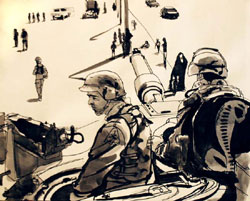
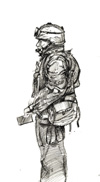
Flack jackets, helmets, rifles, a radio, a camera and art supplies It's that time again. Yet another exceptional Baghdad Journal installment from Steve Mumford. As always, his thoughtful article provides a useful perspective on what's going on in Iraq. Some choice quotes: Two American reporters for AP are going back to Baghdad the next day, leaving a Russian, a Frenchman, a Romanian and an Australian. Surprisingly to me, they're generally impressed with the friendliness and professionalism of the soldiers.Damn straight. At one point, he describes following a two-man sniper team around town (emphasis mine). We cross through a dozen homes like this, avoiding the street so that people won't be able to figure out where we're going.The reference to the camera and the art supplies made me laugh, and that it wouldn't be that unusal for such a mix to occur also seemed appropriate (even if it wasn't intentionally called out that way). As always, the entire column is worth reading in its entirety. If you're not familiar with Mumford's Baghdad Journal, I highly recommend checking out all his past columns, which I collected here. Good stuff. Posted by Mark on April 05, 2004 at 08:57 PM .:
link
:. ![]()
Friday, October 03, 2003
Is that all you got? For the past few weeks, my chain-smoking monkey underlings and I have been running across various stories or thoughts and it's high time I actually find some time to post them. Some of them you've no doubt seen before (that's what I get for sitting on them so long), but they're worth posting anyway, so here goes.
Posted by Mark on October 03, 2003 at 10:08 AM .:
link
:. ![]()
Tuesday, August 05, 2003
Drawing Lines in the Sandbox As 160,000 coalition troops stormed into Iraq last March, thirteen artists (some military, some civilian) were commissioned to depict coalition forces in action. WSJ.com (their link requires a paid subscription, so I am relying on pull quotes from other blogs) reported:
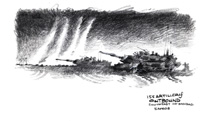
Sgt. Jack Carrillo and Staff Sgt. Michael Fay went for the U.S. Marine Corps. Their assignment: to depict fellow Marines in action. "During the tank battles, I was out there drawing," Sgt. Carrillo says. "When you are out there and you're under that duress, your art picks up a certain freshness and vibrancy." On his second day in-country, "our Humvee flipped over in a night firefight and all my watercolors and paints were just trashed." So he produced more than 200 pencil sketches depicting everything from slain enemy soldiers to the time "our whole battalion was food-poisoned in Baghdad."Here are all of the USMC Military sketches for Operation Iraqi Freedom. As Sylvain Galineau notes, any art with respect to the military is generally regarded with distain in most art circles, which only makes these artists more intriguing. Since I can't read the article I can't see the specific details but from what I understand, the civilians were outfitted in body armor and khakis, but were armed only with a paintbrush (or charcoal). These men risked their lives to produce art that is detested by most of their colleagues. I'm not too familiar with combat art like this, but this is truly intriguing.
Apparently, combat art has been around since people began using the burnt end of a stick on cave walls to recount their hunting exploits for future generations. Since then, combat art has depicted WWII and Vietnam, and I'm sure countless other conflicts. Sgt. Jack Carrillo actually commented at Chicago Boyz and left a link to all USMC Military sketches from the war, which look great. I did some other checking around, and I found this pdf article which also mentions Carrillo and provides a brief introduction to combat art...Generally, the task of capturing combat events in a visual form is left to cameras (which were also active during Iraqi Freedom), but Operation Iraqi Freedom was the first time an active-duty Marine was assigned to a combat zone with the explicit mission of capturing combat events on paper with graphite and charcoal. [thanks to Chicago Boyz for peaking my interest] Posted by Mark on August 05, 2003 at 07:43 PM .:
link
:. ![]()
Monday, July 07, 2003
Heard, Understood, Acknowledged R. Lee Ermey, the infamous drill instructor from Full Metal Jacket, has his own T.V. show, called Mail Call. I've seen it several times before, but I never really got into it. You see, its on regular cable T.V. so his speech is somewhat... toned down - and so we're missing out on half the fun! There aren't any grabastic pieces of amphibian shit on his show. There isn't even any neck-shitting, no steers or queers either, and certainly no skull-fucking! About the worst thing I've heard him say on that show is "Maggot"... I guess some things are the same. He's still not a bigot, for instance. Ok, so that's just a superficial complaint (and a nice excuse to link to some fun sound clips:P) and I happened to catch the back half of his show tonight, and I really enjoyed it. This season, his shows are being broadcast live from the Gulf, and from what I saw, they're great. Because of his military background, he's able to develop an instant rapport with the troops, and it shows. There is an effortless sense of mutual respect there that just can't be faked. Its also nice to see the spotlight on our courageous and honorable fighting men and women. They're doing a fantastic job over there, so far from home, and I'll bet they really enjoyed this visit from Gunnery Sergeant Ermey... At one point, a lucky marine was demonstrating their chemical protection gear and after everything was explained, R. Lee says that maybe we should get that marine out of the gear before he suffocates... "But not before you drop and give me 20!" (again, Ermey is more... respectful... than he used to be). The bundled marine instantly moved to start his assigned pushups - Ermey had to walk over and pat him on the shoulders and tell him he was joking. It was a great moment. HUA! Apparently, Ermey's going to be visiting all the military bases in the region (this episode was in Kuwait - I wonder if he ran into L.T. Smash...) so it should make for an interesting series... Check it out, maggot! Posted by Mark on July 07, 2003 at 09:52 PM .:
link
:. ![]()
Friday, April 18, 2003
Positive Ends Towards a Strategy of Positive Ends by Huba Wass de Czege and Antulio J. Echevarria II [pdf version] : America's role in the world today is a bit of a question mark, and it has been since the end of the Cold War. There have been a lot of proposals by defense planners in recent years, but few of them go beyond the Cold War paradigm of threat-based strategic thinking. Such proposals are based on preventative measures (deterring or defeating specific threats, for example), but prevention is a negative aim; this document proposes an effort of creating positive conditions, those that promote long-term peace, stability, and prosperity. The strength of such a strategy is that it would prevent many threats before they emerge in the first place. Interestingly, this strategy differs from its preventative alternatives in that it is oriented toward achieving a condition, rather than preparing to respond to specific threats. The major weakness of this approach is that others could misconstrue its goals as a form of Pax Americana. Another weakness is that positive aims generally require more energy and resources than its alternatives do. These weaknesses notwithstanding, a strategy built around positive ends permits the United States to define its vital interests in terms of conditions-such as peace, freedom, rule of law, and economic prosperity-rather than as the containment or defeat of inimical state or non-state actors.In theory, I rather like this optimistic approach, but there were some worrying aspects of the essay that make it seem as if a strategy of positive ends might not be as practically applicable as it may seem. In particular, though it does away with the Cold War notion of threat based analysis (which depends entirely on developing a correct list of threats and could fail when confronted with a new or emerging threat which our forces are not trained or equipped to handle), it stubbornly holds to the notion that stability above all is the most important factor of international policy. At a high level, of course, stability is something to be desired, but not at the expense of the overall good. Particularly worrying is the assertion that a good example of achieving positive ends is the non-military sanctions applied to Iraq during the 90s. Still, this is an interesting proposal, but it's worth noting that it was published in September of 2001, at which point, the world and America's place in it changed drastically. Interestingly enough, one of the biggest triumphs of the present war in Iraq owes its success (at least partially) to the theories of one of the authors: Huba Wass de Czege. In 1982, Wass de Czege rewrote US Army doctrine, outlining a strategy emphasizing agility, speed, maneuver, and deep strikes well behind enemy lines. In 1983, he founded the School for Advanced Military Studies, which was set up explicitly to start implementing this new doctrine. By the time Desert Storm got underway, his ideas had begun to take hold and were important to the ground campaign. When we went to Afghanistan, Wass de Czege's ideas had taken an even stronger hold, as the campaign was truly a cooperative effort (one of his goals was to create a military which coordinated efforts between several branches of the armed services ) The most amazing thing about Operation Iraqi Freedom has been the agility, flexibility and active cooperation among all branches of the armed services (Army, Navy, Air Force, Marines) and special operations. Writing a new doctrine is one thing, but having it actually work on the battlefield is a true achievement, and one has to wonder how much weight ideas such as this strategy of positive ends carries... I suppose now is the perfect time to implement this strategy of positive ends; Iraq is truly in need of a serious commitment of resources and energy to bring about a peaceful, prosperous, free state, and such a commitment could seriously imply further reform on the region. If we're able to overcome the weaknesses of this strategy (i.e., being portrayed as Pax Americana), I could see it succeeding... Update 4.27.03 - More on the US mistake of valuing stability above all here. Posted by Mark on April 18, 2003 at 07:40 PM .:
link
:. ![]()
Wednesday, March 19, 2003
Footnotes in Iraq - The opening paragraph from Thomas Pynchon's novel Gravity's Rainbow Posted by Mark on March 19, 2003 at 10:23 PM .:
link
:. ![]()
Sunday, March 16, 2003
Essentially Annihilated Tactical Nuclear Weapons in Southeast Asia : A recently declassified 1966 study performed for the Defense Department which evaluated, and rejected, the hypothetical use of tactical nuclear weapons in Vietnam. The linked page contains a copy of the actual report, as well as related analyses concerning present day implications (for terrorism, among other things). Some choice quotes: "The use of TNW [tactical nuclear weapons] in Southeast Asia would be highly damaging to the U.S. whether or not the use remains unilateral." (7)The implications of this report are arguable, but most of the analysis appears to lean towards the idea that the report is just as valid today as it was in 1966. In any case, its certainly not a bad idea to regularly revisit the issue, as the Bush administration has apparently done (against great criticism by those who don't understand or don't want to admit that military planning for unpleasant (to put it lightly) scenarios is necessary and does not constitute actual military action). Posted by Mark on March 16, 2003 at 02:33 PM .:
link
:. ![]()
Wednesday, February 20, 2002
Way of the Gun Two stories of the pistol by Roninspoon : Utterly compelling stories about the Entry Control Point (more commonly known as a gate) of a patriot missile site in Saudi Arabia. Oddly enough, the conficts described here are not of attacking forces, but rather, internal ones. You see, its a general rule that the gate guard has absolute authority that exceeds the rank of anyone entering his area of responsibility. As usual, there are those who believe that the rules don't apply to them... (it made me laugh when I saw someone referred to as Tallman). Mr. Spoon has also written a few other military stories (Army stories, Sir! Now with %5 more fiction.), none of which are quite as gripping as his pistol stories, but worthy of a read nonetheless. Along similar lines is an article critiquing the portrayal of naval operations in Star Trek: The Next Generation. The article is an interesting read, as ST:TNG was way off base on a number of issues, but the portion of the essay that deals with the distinction between line officers and staff officers is fascinating (as most people don't even know that the distinction exists). In the US Army, Line is infantry, armor, artillery, engineers, and helicopter pilots. Staff is medical, chaplains, quartermaster, transport, intelligence, etc... If a Second Lieutenant of the infantry (a line officer) gives an order to a surgeon whose rank is full colonel (but nonetheless a staff officer), military courtesy demands that it be phrased as a "request", but military law firmly establishes that it has the force of an order, and if the surgeon refuses to carry it out, he risks court martial.This concept is fascinating, and I suppose it applies to Roninspoon's stories above as well. If, for example, an Army engineer is clearing a minefield, I would assume he has rank over anyone on the field (excluding higher ranking engineers, etc.), just as 'Spoon had authority over anyone in the dead zone. Of course, ST:TNG got this completely wrong, having Counselor Troi and Dr. Crusher sometimes take command of the ship, when, in fact, any line officer, even an ensign, should be in charge. Oh, and yeah, sorry about that whole not-updating-for-almost-a-month thing. I think I've got some cool stuff on the horizon, so I'll try and keep on top of it. Posted by Mark on February 20, 2002 at 05:44 PM .:
link
:. ![]()
Friday, November 02, 2001
Blackhawk Down Blackhawk Down by Mark Bowden : An amazingly detailed, 29 part series concerning the Battle of Mogadishu. On Sunday, Oct. 3, 1993, attack helicopters dropped about 120 elite American soldiers into a busy neighborhood in the heart of Mogadishu, Somalia. Their mission was to abduct several top lieutenants of Somalian warlord Mohamed Farrah Aidid and return to base. A variety of logistic and intelligence miscalculations turned the operation into a military fiasco, as two Blackhawk attack helicopters were shot down, and 3 more were immobilized, stranding the soldiers in the middle of a hostile city for several hours. When they emerged the following morning, 18 Americans were dead and 73 were wounded. The Somalis faired much worse, with 500 dead and over 1000 wounded, many of them civilians (of course, the numbers presented here are estimates). It was the biggest single firefight involving American soldiers since the Vietnam War. Helicopter pilot Michael Durant had been carried off by an angry mob and dragged around the streets. He was still alive, held captive somewhere in the city. In strictly military terms, Mogadishu was a success. The targets of that day's raid, two obscure clan leaders, were apprehended. But the awful price of those arrests came as a shock to the American people, and in the years since that humanitarian mission dissolved into combat, Somalia has had a profound cautionary influence on American foreign policy. Bowden interviewed many of the participating soldiers, and even some of the Somalis they fought against, to create a detailed picture of the firefight. The result is a gripping story, told minute by minute, of an elite fighting force that was stranded in a city where literally everyone in the city was trying to kill them. Their strict egagement orders (not to fire unless fired upon) were quickly thrown out the window as soldiers fought for their lives, oftentimes just firing into a crowd of civilians and Somalian soldiers. There are a few drawbacks to the series, most notably the lack of context about why the battle was fought, but overall, it is excellently done. It makes me wonder how this current war on terrorism will play out. If we are serious about the war, firefights like this one are bound to happen routinely... Posted by Mark on November 02, 2001 at 09:20 AM .:
link
:. ![]()
Friday, April 13, 2001
The Book of Five Rings Miyamoto Musashi is an interesting fellow. A ronin (masterless samurai), he roamed feudal Japan in the early 17th century regularly fighting scores of men alone, and winning. Late in life, he dictated the secrets he had learned throughout his travels, calling it The Book of Five Rings. Each of the first four rings (Earth, Water, Fire, Wind) deals with a different aspect of overcoming adversity, while the last ring reveals what he saw as the innermost tenet of his philosophy. I was introduced to this subject by a rather elegant 5k entry. Vote here. Posted by Mark on April 13, 2001 at 12:41 PM .:
link
:. ![]() |
Where am I?
This page contains entries posted to the Kaedrin Weblog in the Military Category. Inside Weblog Archives Best Entries Fake Webcam email me Kaedrin Beer Blog Archives November 2012 October 2012 September 2012 August 2012 July 2012 June 2012 May 2012 April 2012 March 2012 February 2012 January 2012 December 2011 November 2011 October 2011 September 2011 August 2011 July 2011 June 2011 May 2011 April 2011 March 2011 February 2011 January 2011 December 2010 November 2010 October 2010 September 2010 August 2010 July 2010 June 2010 May 2010 April 2010 March 2010 February 2010 January 2010 December 2009 November 2009 October 2009 September 2009 August 2009 July 2009 June 2009 May 2009 April 2009 March 2009 February 2009 January 2009 December 2008 November 2008 October 2008 September 2008 August 2008 July 2008 June 2008 May 2008 April 2008 March 2008 February 2008 January 2008 December 2007 November 2007 October 2007 September 2007 August 2007 July 2007 June 2007 May 2007 April 2007 March 2007 February 2007 January 2007 December 2006 November 2006 October 2006 September 2006 August 2006 July 2006 June 2006 May 2006 April 2006 March 2006 February 2006 January 2006 December 2005 November 2005 October 2005 September 2005 August 2005 July 2005 June 2005 May 2005 April 2005 March 2005 February 2005 January 2005 December 2004 November 2004 October 2004 September 2004 August 2004 July 2004 June 2004 May 2004 April 2004 March 2004 February 2004 January 2004 December 2003 November 2003 October 2003 September 2003 August 2003 July 2003 June 2003 May 2003 April 2003 March 2003 February 2003 January 2003 December 2002 November 2002 October 2002 September 2002 August 2002 July 2002 May 2002 April 2002 March 2002 February 2002 January 2002 December 2001 November 2001 October 2001 September 2001 August 2001 July 2001 June 2001 May 2001 April 2001 March 2001 February 2001 January 2001 December 2000 November 2000 October 2000 September 2000 August 2000 July 2000 Categories 12 Days of Christmas 2006 Movie Awards 2007 Movie Awards 2008 Movie Awards 2009 Movie Awards 2010 Movie Awards 2011 Fantastic Fest 2011 Movie Awards 6 Weeks of Halloween Administration Anime Arts & Letters Atari 2600 Beer Best Entries Commodore 64 Computers & Internet Culture Disgruntled, Freakish Reflections Harry Potter Hitchcock Humor Link Dump Lists Military Movies Music Neal Stephenson NES Philadelphia Film Festival 2006 Philadelphia Film Festival 2008 Philadelphia Film Festival 2009 Philadelphia Film Festival 2010 Politics Science & Technology Science Fiction Security & Intelligence The Dark Tower Uncategorized Video Games Weblogs Weird Movie of the Week ![]() |
Copyright © 1999 - 2012 by Mark Ciocco.
|