| Hitchcock | |||||||
|
Sunday, July 15, 2007
Notorious Filling in some of the holes in my movie viewing history, I recently watched Alfred Hitchcock's classic, Notorious. As Roger Ebert notes, it "contains some of the most effective camera shots in his--or anyone's--work" and so I figured let's take a closer look at some of those great shots. Some are more famous than others, and I'm certainly going to leave off a few, but this should be interesting. Major spoilers ahead, mostly below the fold. First up is a minor shot, not really significant among the Notorious scenes, but more significant of Hitchcock's work as a whole. Many of Hitchcock's films indirectly employed the use of voyeuristic framing to make the viewer feel like they are witnessing the events portrayed on screen. The shot below is literally framed in a doorway, and the distance from the actors implies that we're not supposed to be there. It's an unsettling technique, one which Hitchcock would reprise effectively in his later classics Psycho and Rear Window. This dynamic is reversed in Notorious during the final shot of the film in which our villain is called back to his house to meet a fate we are only left to imagine, as Hitchock closes the door. Interestingly, both approaches can be upsetting: one because we see something we think we shouldn't, another because we fill in the blanks with our imagination.
More screens, commentary, and spoilers below the fold... I've included several screencaps of the next shot to convey the motion on the screen, but looking at screencaps really doesn't do it justice. Ingrid Bergman's character has just seen her father imprisoned for treason, and has spent the night drinking. The scene starts with an establishing shot of Cary Grant, shrouded in shadows and leaning in a doorway (and also Ingrid Bergman laying in bed, waking up with a headache). Hitchcock then follows Grant in a dizzying point of view shot as he walks across the room, the camera rotating as he moves, until he stands above Bergman. The oblique angles of these shots suggest anxiety and tension, and they underscore not only her hungover state, but also the turbulent state of her life. This technique calls attention to itself, but does not overstate the situation. Interestingly, the situation is recalled towards the end of the film, when Grant enters a different bedroom where Bergman lays sick in a bed. That time, the angles are not oblique, as Grant and Bergman's relationship is solidifying in that scene.
Next is probably the most famous shot in the film. Again, I've got a series of screencaps below, but they don't really do the scene justice. The scene starts with a sweeping high-angle crane shot that pans across the room, then pushes down towards Bergman's hand, which is holding the Unica Key (the key that will open the wine cellar, where it is thought that the villains have hidden something). The high angle of the shot reveals the characters on a checkerboard floor, thus likening the film to a chess match, where the characters are mere pawns. This, of course, has duel meanings. The story revolves around Bergman's relationship with Grant, but the film employs a spy plot in which American intelligence has recruited Bergman to spy on Nazis. So, in a sense, the people involved are really just pawns of war. In another sense, because the shot calls attention to itself, it is clear that the characters are also pawns of the filmmaker. On a commentary track from the Criterion Collection DVD, film scholar Marian Keane notes. The shot demonstrates Hitchcock's supremacy as the author of the film, and does so by revealing the camera's presense; its magical ability to move freely in a house where such freedom is prohibited. And that in Hichtcock's hands, the camera is capable of revealing his intentions, hence his presense behind it.
As previously mentioned, Bergman has stolen a key off of the villain's keychain. They key is to the wine cellar, and Grant wants to see what's hidden in there. Hitchcock employs a brilliant plot element to heighten the tension of these scenes: they are at a party, and the champagne is flowing freely. Perhaps too freely. They might run out, thus necessitating a trip to the wine cellar to fetch some more. But the moment this happens, the villain will be aware that someone has stolen his key. Towards the beginning of this sequence, Hitchcock makes one of his infamous cameos. Typically, when a director makes a cameo, it's seen as a bit of an egotistical thing. Perhaps it is, but in this instance, Hitchcock brilliantly imbues it with a double meaning. As Bergman and Grant move towards the bar to check on the champagne supply, we catch a glimps of Hitchcock downing a glass himself. It's as if he's telling us that he's not going to take it easy on his characters, and that they had better get a move on if they're going to successfully find out what's in the wine cellar.
Of course, the villain notices that his key is gone, and later that night, he goes down to the wine cellar to investigate. Grant and Bergman had accidentally broken a bottle that contained a suspicious powder (which we later figure out is uranium), then hastily cleaned it up as they had to leave the room quickly to avoid detection. Later that night, our villain sees nothing wrong... but decides to look closer. He scans the wine bottles on the shelf. The camera moves from bottle to bottle, displaying a finger and a year. The first several bottles say 1934, but eventually we get to one that is out of place, a 1940 bottle. This is the sort of thing that bad cinema would avoid, favoring lengthy exposition about how the Nazi's employed a labeling system for all their work and that looking at the years would confirm whether or not they had been tampered with. Instead, Hitchcock simply shows us the years, and we figure out what he's looking for.
Of course, there are many other famous shots in the film (such as the first appearance of Madame Sebastian), but I don't have time to go through them all. This film will most certainly end up on my Top 100 list, when I get around to creating it. Last week, I listed a bunch of films I wanted to catch up with before I compiled the top 100 list. I was a little unsure if this was a good idea, though, as great films usually get better with repeated viewings. Would I really find something worth putting on the list after a single viewing? Well, Notorious certainly fits the bill. Of course, I've watched it twice this weekend, and I've watched some of these scenes several times while writing this post, but what do you expect from a truly great film that I loved. It's perhaps not totally perfect, but it's close, and the story hangs together much better than Hitchcock's earlier works (see my Hitchcock category archives for more). To be sure, the spy story is a bit contrived, but the important thing isn't the spying or the Nazis or the uranium, it's Bergman and Grant's relationship. The rest is just window dressing (what Hitchcock infamously refers to as the MacGuffin). There were already 4 Hitchcock films on my preliminary top 100, so this would make 5. It's possible that a sixth will emerge as well, though I think that if that happens, one of the initial 4 will be driven off the list. We'll see, I guess. Posted by Mark on July 15, 2007 at 08:33 PM .:
Comments (0) |
link
:. ![]()
Sunday, May 21, 2006
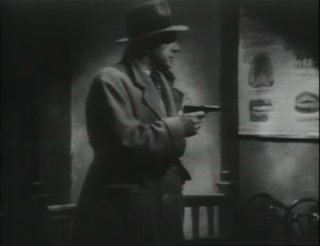
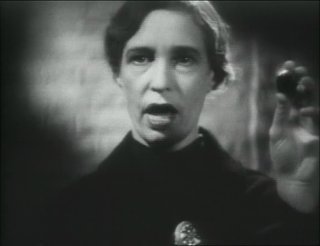
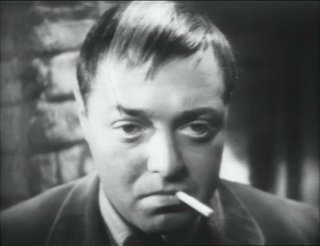
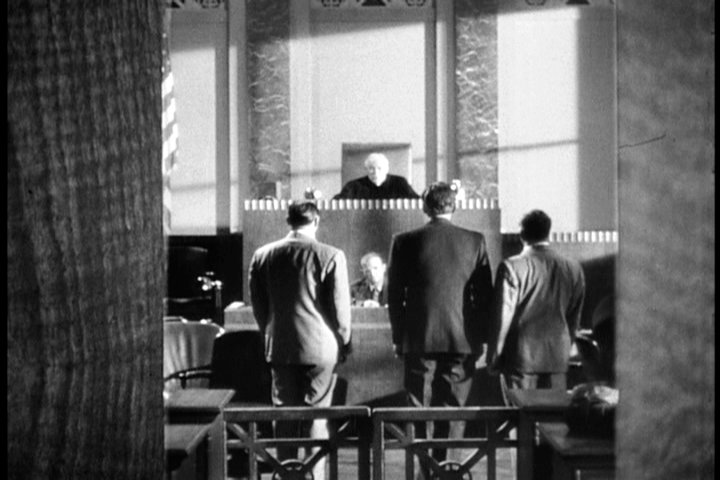
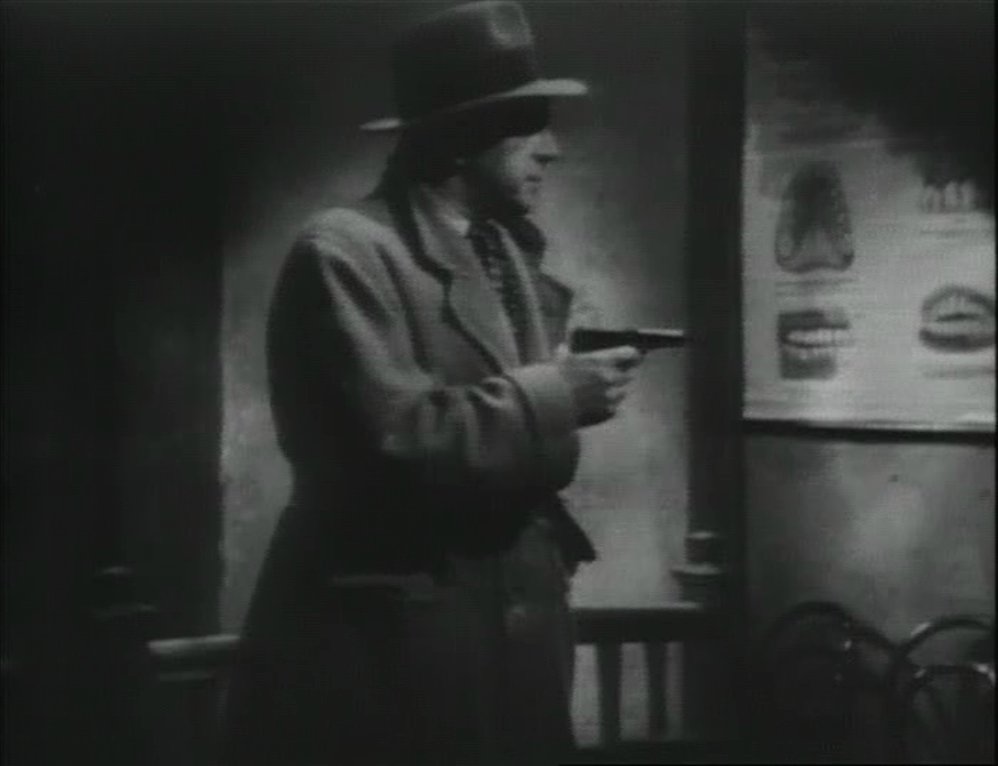
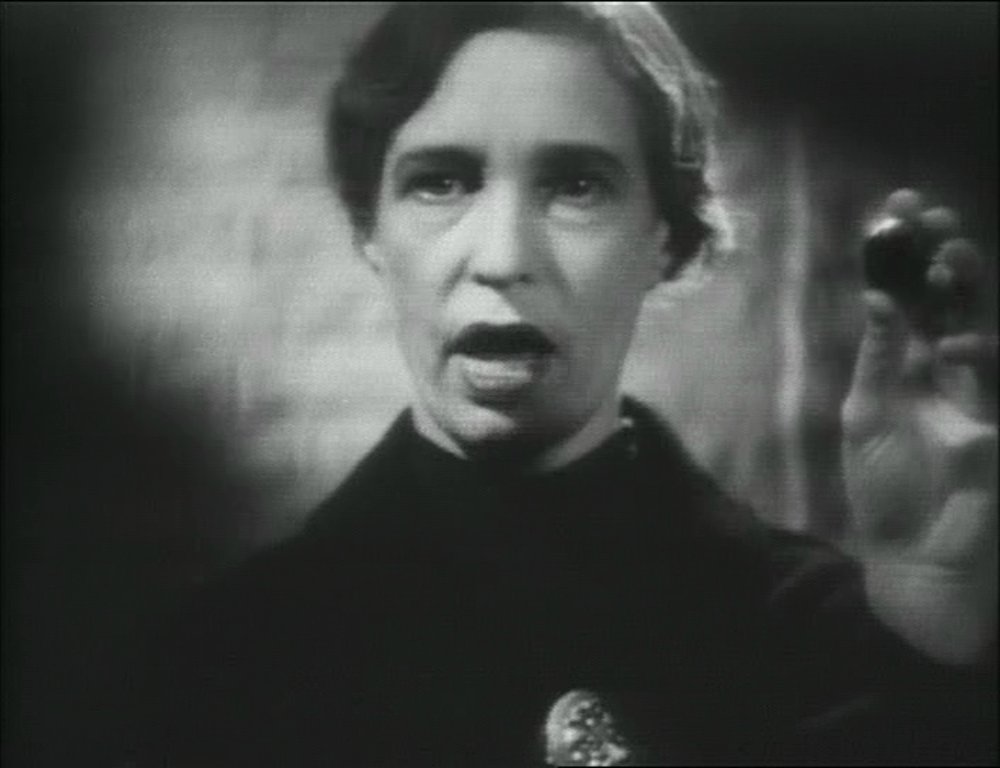
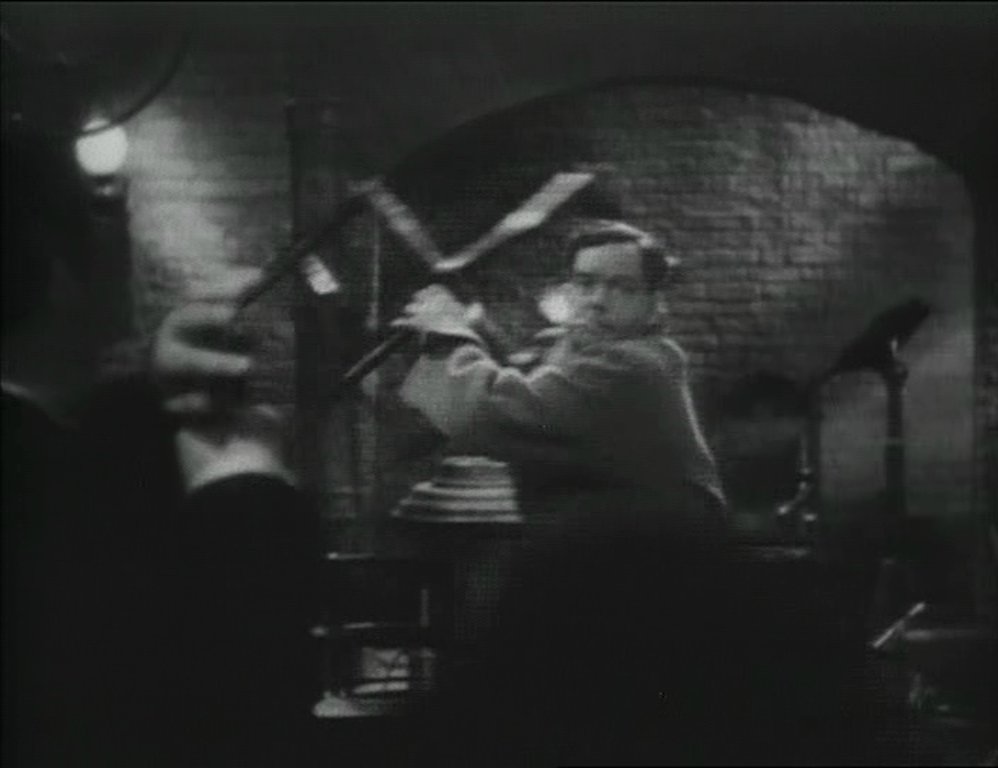
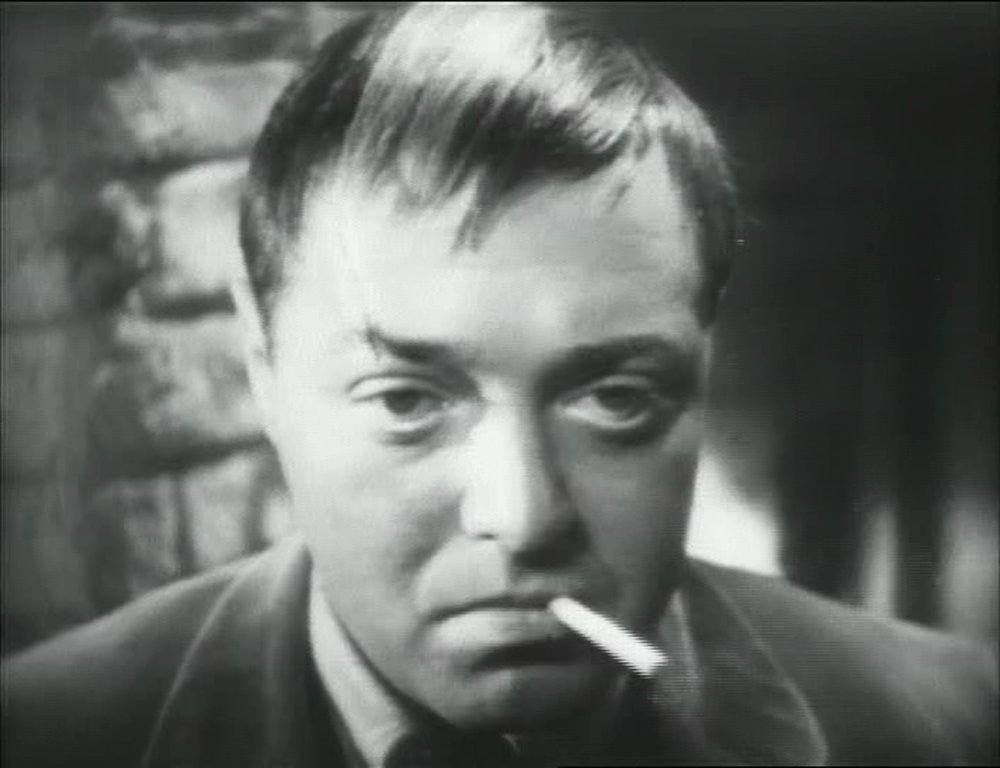
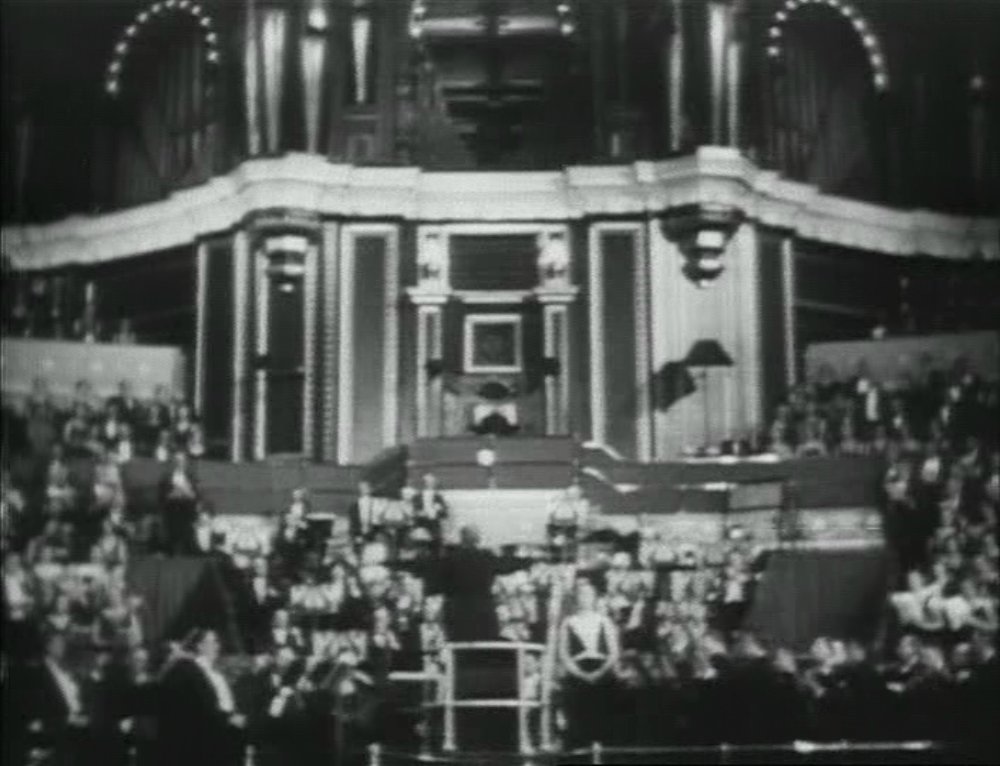
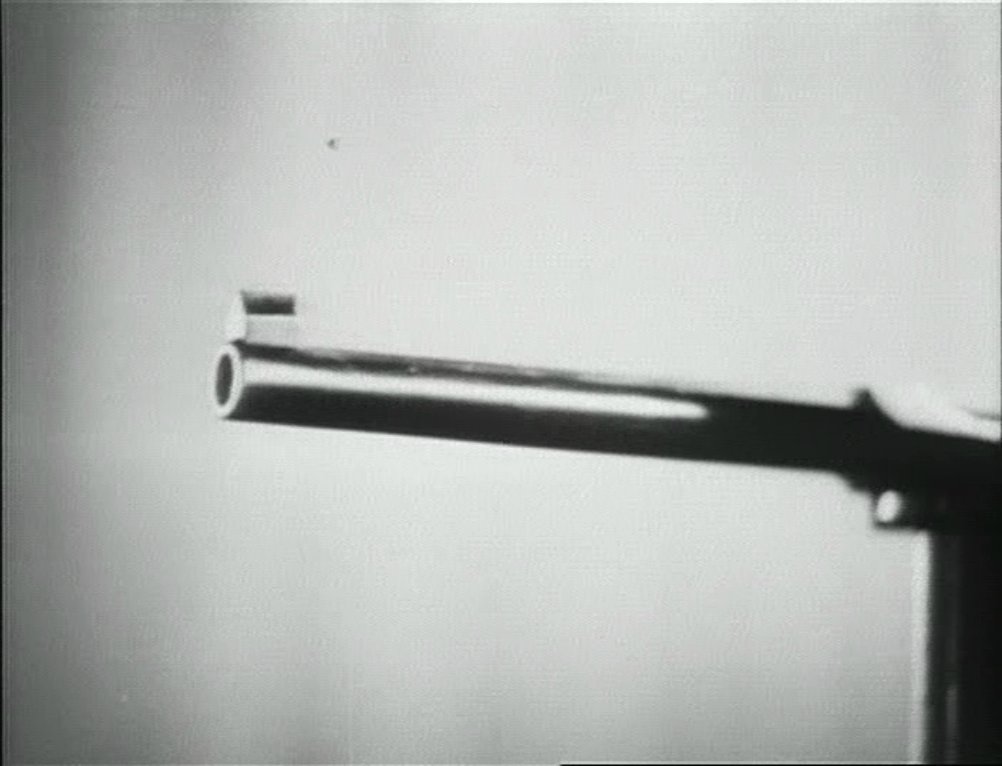
The Man Who Knew Too Much My little Hitchcock marathon continues with the 1934 thriller, The Man Who Knew Too Much. This was a breakthrough international success and it was also critically acclaimed as a new high in suspense films. However, while this film exhibits much more of a mastery of technique than his previous efforts, it's still not indicative of his later brilliance. There are many great scenes and great shots in this movie, but the plotting and pacing problems that plagued his other early films are still in evidence (although there was a big improvement). The plot has enormous holes in it, but the themes and conventions are pure Hitchcock and it's not without a certain sense of charm. The story concerns a married couple vacationing in the Alps with their daughter. They're befriended by a French man who, naturally, is shot. It turns out that the man was a spy, and just before he dies, he tells the couple of a plot to assassinate an important diplomat in London. To keep the couple from talking to the police, the assassins kidnap the couple's daughter and hold her hostage. The movie is filled with excellent scenes and shots, but the plot holes hold the film back from total brilliance. Spoilers, screenshots and more below! The film also displays some Hitchcockian humor, something that was somewhat lacking in his previous films. For instance, there's a clever sequence towards the beginning of the film involving a group of people on a dancefloor that get tangled up in string. Later, a scene at a dentist's office approaches slapstick. ![]() I always bring a gun to the dentist's office. A hilarious scene at a church approaches downright silliness as the father and his friend attempt to communicate by singing plot points to each other to the tune of the hymns (thereby disguising their conversation from their fellow churchgoers). ![]() We must sing the plot now, so as not to be detected. Later, the father's friend gets hypnotized by the head of this (rather strange) Church. Naturally, she's in league with the assassins. ![]() She's not as good as hypnotoad, but she'll do. Cornered by the criminals at the Church, our hero starts a... chair fight. This sequence is literally minutes long, as our hero throws chairs at the criminals, who decide not to use their guns to return fire, but to throw chairs back at the hero instead. By the way, it's not clear in the screenshot below, but if you look closely, you can see that the man has a cigarette in his mouth. That's right, he initiates this chair fight with a cigarette dangling from his mouth. ![]() Chair fight! The assassin was expertly played by Peter Lorre, in his first English speaking role. Cheerfully chewing scenery and smoking like a chimney, his presence helps give the film a large portion of its charm. A testament to how a great villain can elevate a movie... ![]() I am Peter Lorre, hear me roar. One of the most memorable sequences in the film is when the assassins make their move on the diplomat. The shooter times his shot with a key portion of the music at a concert, and Hitchcock employs a brilliant dissolve from the orchestra to the gun (the screenshots below don't do it justice).
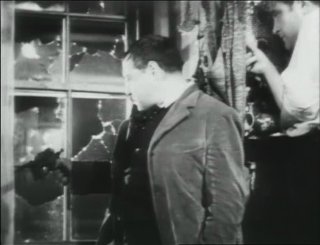
Believe it or not, our heroine manages to help foil the assassination attempt, and the police are able to follow the shooter back to his group's hideout (the aforementioned Church). This leads to a siege and eventual shootout, which was apparently based on Siege of Sidney Street, a notorious real-life gunfight in London's East End in 1911. ![]() Didn't you hear me, I am Peter Lorre! Rarr! The film ends with the daughter escaping to the roof, chased by this pleasant fellow: ![]() I'm nowhere near as cool as Peter Lorre. Once again, we've got a film which shows flashes of Hitch's future brilliance without being, in itself, brilliant. Still, there's much more substance here than in the previous films in my marathon. It's an archetype of his later work and indeed, Hitchcock remade the film nearly 20 years later (though critics disagree about which version is better). Update: You can download the movie at the Internet Archive! Posted by Mark on May 21, 2006 at 08:05 PM .:

Comments (1) |
link
:. ![]()
Sunday, February 12, 2006
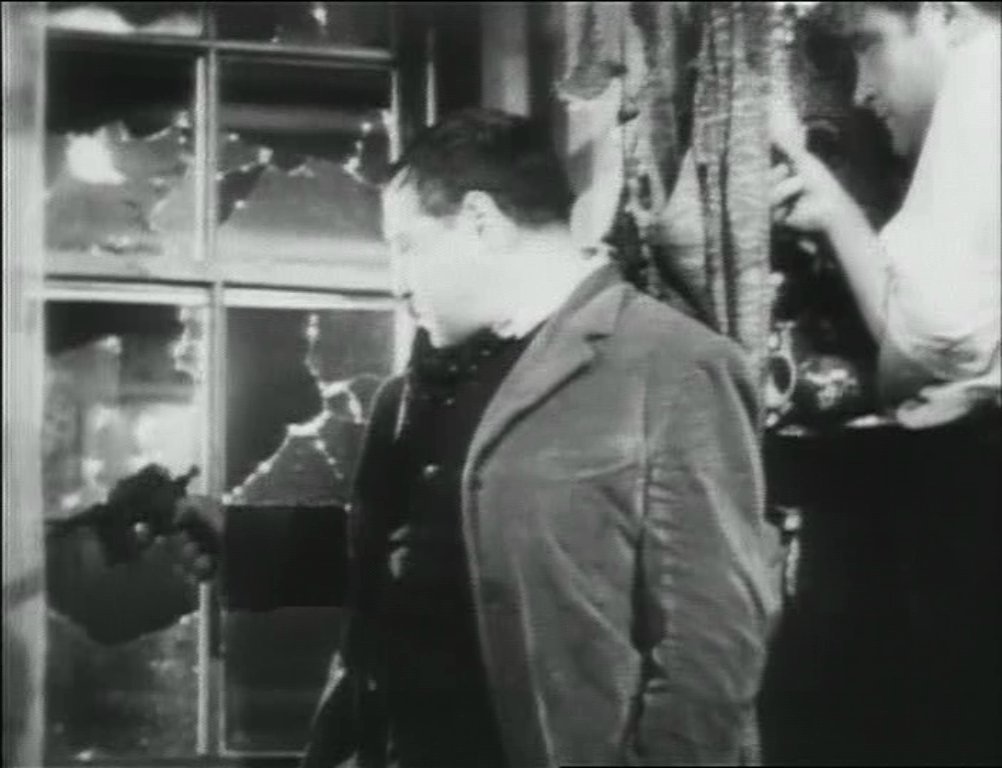
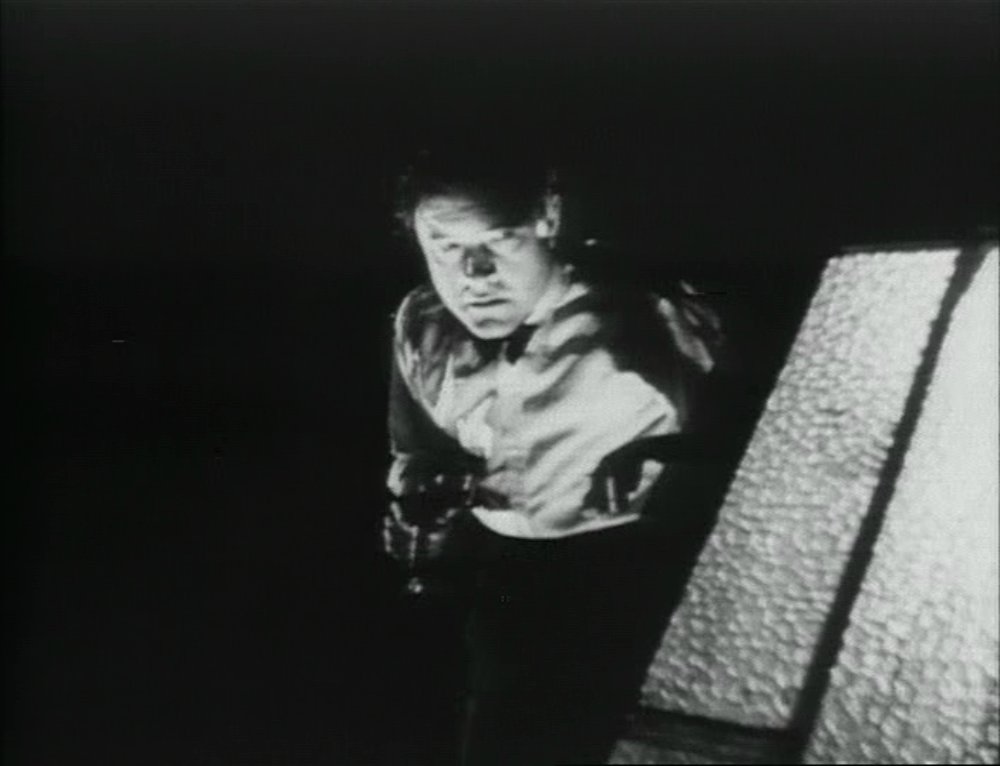
Early Hitchcock A little while ago, I came into the possession of a collection of 9 early Alfred Hitchcock films (i.e. 1920s and 1930s, his pre-Hollywood films). Since Cinecast (a film podcast) was doing a Hitchcock Marathon, I decided to play along in a manner of speaking (the major difference being that I'm going to watch more than the 6 films they've selected... in fact, the only film on their list that's currently in my collection is The 39 Steps). I started my marathon with one of Hitchcock's first efforts, a 1926 silent film called The Lodger. I enjoyed the film a lot, though it had a lot to do with the context and conventions of silent films. Moving in chronological order, I've progressed through three more films: Blackmail, Rich and Strange, and Number 17. During the Cinecast marathon, the hosts of the show referred to one of Hitch's final efforts as "Minor Hitchcock, the work of a director whose best days are clearly behind him." With the films I've seen so far, I'd have to also classify them as Minor Hitchcock. However, these films are the work of a director whose best days are clearly ahead of him. Even as early as The Lodger, you can see Hitchcock's standard themes developing as well as flashes of his future brilliance. I'm only four films in though, and I'm fairly certain that the later films in the collection will pick up a bit... More thoughts on all three, including Spoilers as well as a few screenshots (with the typical sarcastic captions) below the fold... Blackmail (1929): One of the first British "talkies," this film started production as a silent film and the producers decided to change part-way through the production. As such there are actually two versions of the film, one silent, and one with sound, though the version with sound (the one I saw) seems to be the best remembered version. The movie tells the story of Alice White, a woman dating a policeman named Frank. She's bored with Frank and decides to mess around with an artist. To make a long story short with the help of spoilers, the artist is a perv who attempts to rape Alice so she kills him with a breadknife that just happens to be conveniently located on the bedstand: (Click images for a larger version) ![]() I used this knife for bread, and only bread. This is the face I make when I'm cutting bread. Rich and Strange (1931): Offbeat, a little uneven, and seemingly out-of-character for Hitchcock, this film follows the story of Fredy and Emily as they unexpectedly come into money and decide to cruise around the world. The couple eventually winds up becoming romantically entangled with other passengers. Hijinks ensue. Aside from the ending, this film isn't what you'd typically expect from Hitchcock - it's more of a romantic comedy than anything else. Even visually, I wasn't particularly impressed. It's good at what it does, but was a little too slow for me... Number 17 (1932): This film follows a gang of thieves who have stashed their loot in a safehouse. The police are hot on their heels, of course, but they have an escape plan. This film is most notable for Hitchcock's obvious experimentation with the medium. Hand held cameras, movement, and quick cuts are all used effectively. Making extensive use of candlelight, he plays with lighting and shadows throughout the film: ![]() Stepping through my shadow... ![]() No, these are not obviously miniatures. ![]() No miniatures here, move it along. Again, these early films show glimpses of Hitchcock's future brilliance, but are not especially brilliant in themselves. There were a lot of plotting and pacing problems in particular, though I do wonder how my modern perspective affects my perception of these movies. As with The Lodger I wonder how much of the impact of these films is lost because of the modern, cynical attitudes towards storytelling. As I said in my previous post: These days, we're so zonked out on Lost and 24 that our minds immediately and cynically formulate all the ways the filmmakers are trying to trick us. Were audiences that cynical 80 years ago? Or did the ending truly surprise them?And, of course, the more pressing question: did people really leave loaves of bread and knives on their bedstands? Posted by Mark on February 12, 2006 at 10:07 PM .:
Comments (0) |
link
:. ![]()
Tuesday, December 27, 2005
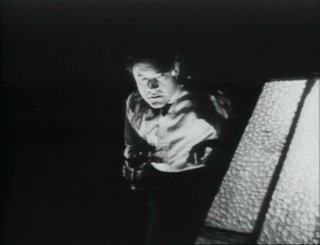
Silent Hitchcock Browsing the discount DVD rack while doing a little last-minute shopping, I came across this collection of 9 Hitchcock films for a measly $8. I love Hitchcock, yet I haven't seen many of his films (and he was an extremely prolific director), so I picked it up. It turns out that all of the films on the DVDs are from Hitchcock's pre-Hollywood period, dating from the mid 1920s to the late 1930s. It even includes a 1927 silent film, among Hitchcock's first efforts, called The Lodger. By today's standards (or even the standards set by Hitchcock's later work), it's not especially impressive, but I haven't seen much in the way of silent films, so this particular movie intrigued me. The conventions of silent films are different enough from what we're all familiar with that it almost seems like a different medium. The film moves at a very deliberate pace, revealing information slowly in many varied ways (though, it seems, rarely through dialogue). In fact, I even played around with watching the film at 2X speed and didn't have any problem keeping up with what was happening on screen. Not having any real experience with silent films, I don't know if this (or any other aspect of the movie) was unusual or not, but it seemed to work well enough. Details, screenshots, sarcasm and more below the fold. Also Spoilers, but if you're up for it, you can watch the movie at World Cinema Online... (Click images for a larger version) ![]() The killer had a long nose and floppy ears. From the Fog and the Constable, it's obvious London is under the grip of a Jack the Ripper style serial killer called "The Avenger." The film opens just after a murder with a lady describing our villain to the police.
Here we see a few of the varied ways in which the film communicates information about the murder to the audience. From these scenes (among others), we gather the following facts about the killer:
![]() I'm not a murderer! Excellent reveal of the Lodger. I think this is the most striking image in the film, and it immediately set off warning bells in my head. ![]() No, really, I'm not the Avenger! ![]() See, without my hat and scarf, I'm much creepier. Woops, I mean less creepier. Yeah. ![]() You gonna get it, woman! The-man-who-is-clearly-not-The-Avenger is playing chess with the Landlady's fair-haired daughter Daisy, who has deftly outmaneuvered her non-murderous opponent. At this point, he literally says "Be careful. I'll get you yet." No foreshadowing here, move along... Oh, and despite the fact that the Lodger is clearly a psychopath, Daisy is falling for him, much to the dismay of Joe, her policeman friend (who happens to be investigating some series of murders or something). ![]() You're under arrest, weenie. The characters in the film have finally figured out that the new lodger is The Avenger, and policeman Joe searches the premesis and finds a hidden bag in his room containing a map of all the killings, various newspaper clippings, and a photograph of the oddball with one of the victims. Our villain is handcuffed but promptly escapes with the help of Daisy (who thinks he's innocent, of course). ![]() Wha-wha-wha-whaaaat? "My God, he is innocent! The real Avenger was taken red-handed ten minutes ago." Ah Ha! Hitchcock strikes again. ![]() Rabble, Rablle, Rabble! Rabble! Oh no, someone spotted the handcuffs! An angry mob has emerged and is chasing the now-exonerated Lodger. For a moment, I really wondered if the mob would take him out, but it seems that film noir hadn't yet emerged, as our beloved Lodger takes a beating, but ends up fine. And he gets the girl, too: ![]() I love you, weenie. In case you can't tell from all the sarcasm, the "twist" at the end of the story wasn't exactly earth-shattering. These days, we're so zonked out on Lost and 24 that our minds immediately and cynically formulate all the ways the filmmakers are trying to trick us. Were audiences that cynical 80 years ago? Or did the ending truly surprise them? To be honest, there was a part of me that thought that he really could have been the killer. Also, as I hinted at above, this film seems to resemble film noir, and the angry mob scene was somewhat effective in that light. Ultimately, I enjoyed the film greatly, even if much of my fascination has to do with the context and conventions of silent films. This was apparently the first film where Hitchcock really displayed his own style, and you really can see a lot of themes in this film that would later become Hitchcock staples (i.e. the wrongly accused man, voyeurism, etc...). More on the background of the film can be found at this Wikipedia entry. So one film down, eight to go. I have to admit, part of the inspiration to get this set is that Cinecast is currently doing a Hitchcock marathon, though it seems that the only film on their list that is in this DVD set is The 39 Steps. Posted by Mark on December 27, 2005 at 12:52 AM .:
Comments (0) |
link
:. ![]() |
Where am I?
This page contains entries posted to the Kaedrin Weblog in the Hitchcock Category. Inside Weblog Archives Best Entries Fake Webcam email me Archives September 2008 August 2008 July 2008 June 2008 May 2008 April 2008 March 2008 February 2008 January 2008 December 2007 November 2007 October 2007 September 2007 August 2007 July 2007 June 2007 May 2007 April 2007 March 2007 February 2007 January 2007 December 2006 November 2006 October 2006 September 2006 August 2006 July 2006 June 2006 May 2006 April 2006 March 2006 February 2006 January 2006 December 2005 November 2005 October 2005 September 2005 August 2005 July 2005 June 2005 May 2005 April 2005 March 2005 February 2005 January 2005 December 2004 November 2004 October 2004 September 2004 August 2004 July 2004 June 2004 May 2004 April 2004 March 2004 February 2004 January 2004 December 2003 November 2003 October 2003 September 2003 August 2003 July 2003 June 2003 May 2003 April 2003 March 2003 February 2003 January 2003 December 2002 November 2002 October 2002 September 2002 August 2002 July 2002 May 2002 April 2002 March 2002 February 2002 January 2002 December 2001 November 2001 October 2001 September 2001 August 2001 July 2001 June 2001 May 2001 April 2001 March 2001 February 2001 January 2001 December 2000 November 2000 October 2000 September 2000 August 2000 July 2000 Categories 2006 Movie Awards 2007 Movie Awards Administration Anime Arts & Letters Atari 2600 Best Entries Computers & Internet Culture Disgruntled, Freakish Reflections Harry Potter Hitchcock Humor Link Dump Lists Military Movies Music Neal Stephenson Philadelphia Film Festival 2006 Philadelphia Film Festival 2008 Politics Science & Technology Security & Intelligence The Dark Tower Uncategorized Video Games Weblogs ![]() |
||||||
Copyright © 1999 - 2007 by Mark Ciocco.
|