
| Philadelphia Film Festival 2009 | |
|
Sunday, December 13, 2009
Visual Literacy and Rembrandt's J'accuse Perhaps the most fascinating film I saw at the 18½ Philadelphia Film Festival was Rembrandt's J'accuse. It's a documentary where British director Peter Greenaway deconstructs Rembrandt's most famous painting: Night Watch. It's arguably the 4th most celebrated painting in art history (preceded only by the Mona Lisa, The Last Supper, and the ceiling of the Sistine Chapel...) and Greenaway believes it's also an accusation of murder. The movie plays like a forensic detective story as Greenaway analyzes the painting from top to bottom. It's an interesting topic for a documentary, though I think the film ultimately falters a bit in it's investigation (either that, or Greenaway is trying to do something completely different). (Note, you can click on the images below for a higher resolution image.) ![]() Night Watch Greenaway began his career as a painter and he contends that most people are visually illiterate, which is an interesting point. We really do live in a text-based culture. Our education system encourages textual learning over visuals, from the alphabet to vocabulary and reading skills. The proportion of time spent "reading paintings as they do text" is minute (if it happens at all). As such, our ability to analyze visual art forms like paintings is ill-informed and impoverished. Greenaway even takes the opportunity to rag on the state of modern cinema (which is a whole other discussion, as sometimes even bad movies are visually well constructed, but I digress). In any case, I do think Greenaway has a point here. Our culture is awash in visual information - television, movies, photography, etc... - and yet, we spend very little time questioning the veracity of what we're shown. They say that a picture is worth a thousand words, which is really just a way of saying that pictures can easily convey massive amounts of information. Pictures are inherently trustworthy and persuasive, but this can, in itself, cause issues. Malcolm Gladwell examined this in his essay, The Picture Problem: You can build a high-tech camera, capable of taking pictures in the middle of the night, in other words, but the system works only if the camera is pointed in the right place, and even then the pictures are not self-explanatory. They need to be interpreted, and the human task of interpretation is often a bigger obstacle than the technical task of picture-taking. ... pictures promise to clarify but often confuse. ... Is it possible that we place too much faith in pictures?Gladwell is, of course, casting suspicion on images, but he's actually making many of the same points as Greenaway. What Gladwell is really saying is that human beings are visually illiterate. As Greenaway notes towards the beginning of the film, is what we see really what we see? Or do we only see what we want to see? Both Gladwell and Greenaway seem to agree that interpretation is key (though Gladwell might be a bit more pessimistic about the feasibility of doing so). Though this concept is not explicitly referenced later in the film, I do believe it is essential to understanding the film. One of the first clues that Greenaway examines is the public nature of Rembrandt's painting. For the most part, public museums didn't start appearing until the mid 19th century. The Night Watch, by contrast, was on public display from day one (1642). In a time where paintings were private luxuries, usually viewed only by the rich and those who commissioned the paintings, the Night Watch was viewed by all. In a lot of ways, the painting is unusual and prompts questions, most of which don't seem to have any sort of satisfactory answers. This leads to all sorts of speculation and theories about the motives behind the painting and what it really depicts. One way to look at it is to view it as an accusation. An indictment of conspiracy. Greenaway starts with this idea and proceeds to examine 34 interconnected mysteries about the painting. The mysteries all server to illuminate one thing: The content of the painting. What is it about? Who are the players? What is the accusation? I will not go through all 34 mysteries, but as an example, the first mystery is about the Dutch Militia. At the time of the painting, there was a century-long Dutch tradition of the group military portrait. The Dutch had been involved in a long, drawn-out guerrilla war with the Spanish. Local militias were formed all throughout the country to protect their towns from their enemies. These local companies were comprised of regular citizens and volunteers, many of them important local figures, and they liked to have themselves painted, usually in uniform and in a powerful light to inspire solidarity and confidence. As the war wound down, these militias became less about the military and more about politics and power. It was a prestigious thing to be in a militia and they became more of a gentleman's club than a military organization. In the Night Watch, Rembrandt chose to break many of the traditions associated with the common Dutch military portrait. Many of the future mysteries examine these differences in great detail. After seeing the movie I was struck by numerous things. First, for a filmmaker ostensibly crusading against visual illiteracy, I find it strange that Greenaway has chosen to present his argument as a gigantic wall of text. He narrates the entire film. Occasionally, he'll cut to a "reenactment", which are scenes from his previous film, a fictional retelling of Rembrandt's painting, but even those are comprised primarily of characters spouting dialogue (these scenes rarely provide insight, though it's nice to break up the narration with something a little more theatrical). Indeed, the grand majority of the mysteries are concerned with context (i.e. the cultural and historical traditions, the timing of the painting, who commissioned the painting, etc...). There is a concept from communication theory called exformation that I think is relevant here. Effective communication depends on a shared body of knowledge between the persons communicating. In using words, sounds and gestures the speaker has deliberately thrown away a huge body of information, though it remains implied. This shared context is called exformation.Wikipedia also has an excellent anecdotal example of the concept in action: In 1862 the author Victor Hugo wrote to his publisher asking how his most recent book, Les Miserables, was getting on. Hugo just wrote “?” in his message, to which his publisher replied “!”, to indicate it was selling well. This exchange of messages would have no meaning to a third party because the shared context is unique to those taking part in it. The amount of information (a single character) was extremely small, and yet because of exformation a meaning is clearly conveyed.Similarly, when Rembrandt painted the Night Watch and it was put on display, most of the viewers knew the subjects in the painting and the circumstances in which it was painted. As modern viewers, we do not have any of that shared knowledge. In order to understand the visual of The Night Watch, one must first understand the context of the painting, something that is primarily established through text. For example, one of the mysteries of the painting has to do with the lighting. Rembrandt was one of the pioneers of artificial lighting in paintings, and this was the result of improvements to technology of the day. There were apparently big improvements in the use of candles and mirrors, and so Rembrandt enjoyed playing with lighting, making the painting seem almost theatrical. As modern viewers, this sort of playful use of lighting isn't special - it's something we've seen a million times before and in a million other contexts. In Rembrandt's time, it was different. It called attention to itself and caused much speculation. Modern audiences thus need to be informed of this, and again, Greenaway accomplishes this mostly through the use of text. To be sure, there are some interesting visualization techniques that Greenaway employs when talking about specific aspects of the painting. For example, when discussing the aforementioned use of lighting, Greenaway does his own manipulation, exagerating the lighting in the painting to underline his point:
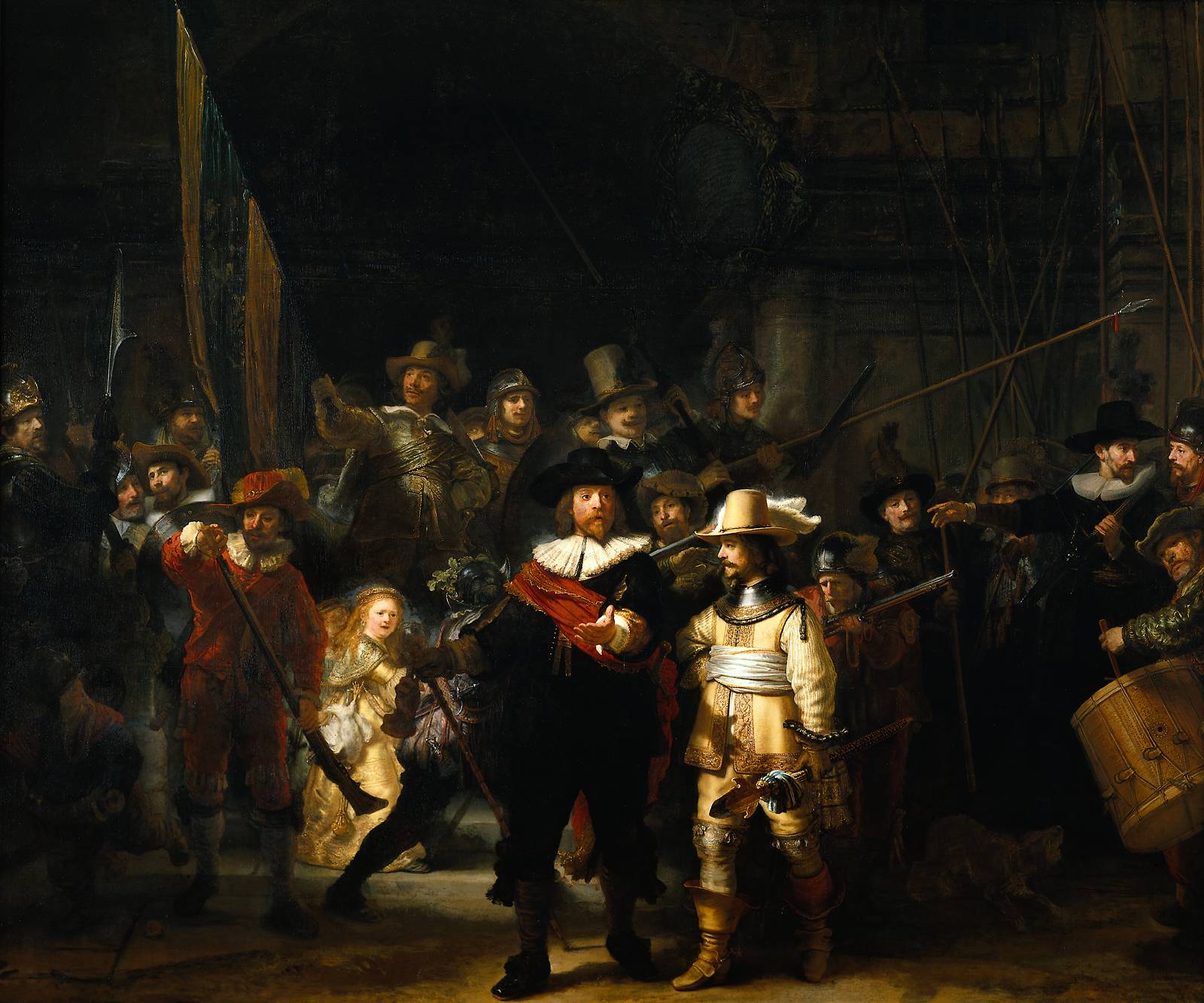
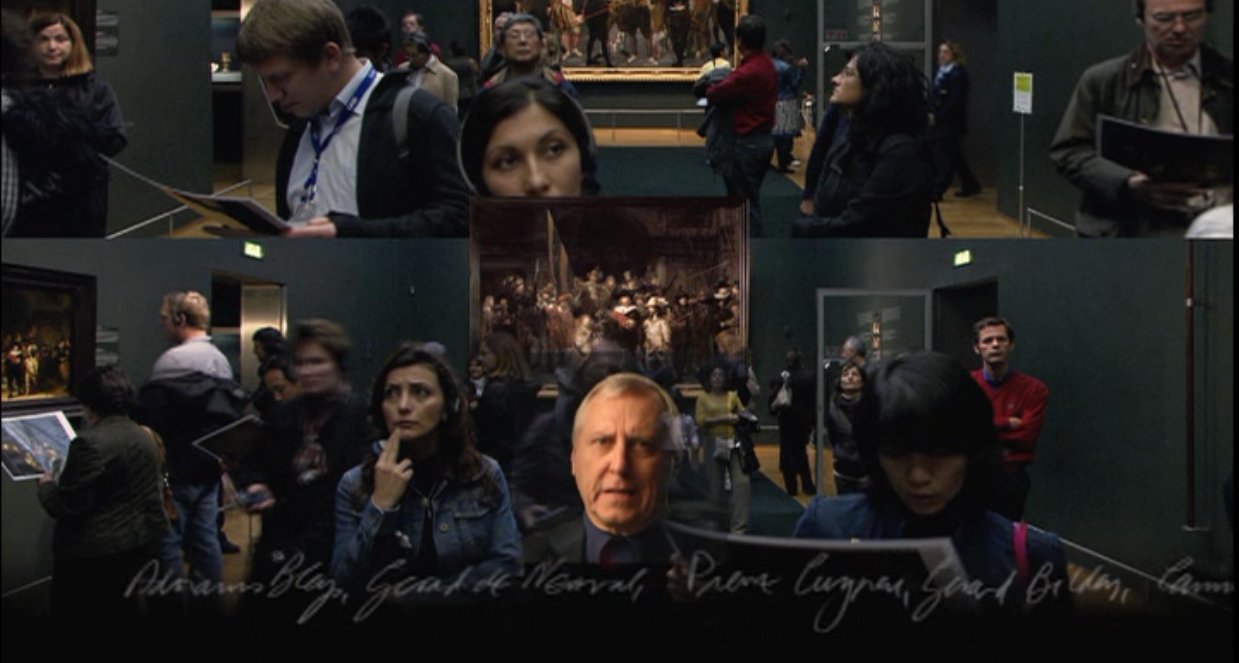
Unfortunately, these are not used as often as I would have hoped, nor are they always necessary or enlightening, and indeed there are numerous distractions throughout. For instance, the frame is often comprised of several overlapping and moving boxes. Sometimes this is used well, but it often feels visually overwhelming. Indeed, sometimes the audio is sometimes also overwhelming - with Greenaway's narration being overlaid on top of music and sometimes even a woman's voice which is saying the names of famous people who have seen Night Watch (the inclusion of which has always confused me). I'm sure it's challenging to make a movie about a painting without just putting up a static shot of the painting (and that's certainly not desirable), but does the screen need to be so busy? The visual components of the film seem to take a back seat to the textual elements... Interestingly, this is a film that seems to work a lot better on the small screen, as it's not nearly as overwhelming on the small screen as it was in the theater. ![]() Visually Overwhelming Furthermore, the text presented to us is so dense that it can be hard to follow at times. This at least partially due to the massive amount of exformation, unfamiliar European names, different cultural traditions, etc... There are 34 people depicted in the painting (plus a dog!), and it can be tough to keep track of who is who. I suppose I should not be surprised that someone obsessed with visual literacy is not a master writer, but perhaps there is something else going on here... Next, I was struck by the inclusion of Greenaway's face, which is often positioned in a box right in the center of the frame. Why do that? Why is he calling so much attention to himself? My first inclination is that it's a breathtakingly arrogant strategy. Also, the sound of his voice (sometimes overly deliberate pronunciation mixed with stereotypical European accent) lends the impression of arrogance and pretentiousness. I think that may still be part of it, but again, there is more going on here. ![]() Look at me! There are many types of documentary films. The most common form of documentary is referred to as Direct Address (also known as Expositional Mode). In such a documentary, the viewer is directly acknowledged, usually through narration and voice-overs. There is very little ambiguity and it is pretty obvious how you're expected to interpret these types of films. Many television and news programs use this style, to varying degrees of success. Ken Burns' infamous Civil War and Baseball series use this format eloquently, but most traditional propaganda films also fall into this category. The disembodied nature of a voice-over lends an air of authority and even omniscience to a film's subject matter (this type of voice-over is often referred to as "Voice of God" narration). As such, these films are open to abuse through manipulative rhetoric and social propaganda. By contrast, Reflexive Documentaries use many devices to acknowledge the filmmaker's presence, perspective, and selectivity in constructing the film. It is thought that films like this are much more honest about their subjectivity, and thus provide a much greater service to the audience. An excellent example of a Reflexive documentary is Errol Morris' brilliant film, The Thin Blue Line. The film examines the "truth" around the murder of a Dallas policeman. The use of colored lighting throughout the film eventually correlates with who is innocent or guilty, and Morris is also quite manipulative through his use of editing - deconstructing and reconstructing the case to demonstrate just how problematic finding the truth can be. His use of framing calls attention to itself, daring the audience to question the intents of the filmmakers. The use of interviews in conjunction with editing is carefully structured to demonstrate the subjectivity of the film and its subjects. As you watch the movie, it becomes quite clear that Morris is toying with you, the viewer, and that he wants you to be critical of the "truth" he is presenting. Ironically, a documentary becomes more objective when it acknowledges its own biases and agenda. In other words, a documentary becomes more objective when it admits its own subjectivity. Greenaway could easily have employed a direct address narration with this film, but he does not. Instead, he conspicuously inserts himself right into the middle of the frame. Indeed, later in the film, Greenaway appears dressed in a ridiculous getup more suited to appear within the painting than in the movie. It's almost like he's daring us to question this visual choice. Why? Perhaps because of the third thing that struck me - Greenaway is the only narrator in the film. Most documentaries feature many talking heads, experts and historians, and even some contrary opinions, among other expositional techniques. This film does not. Why? Could it be that Greenaway's story is complete bullshit? After all, his story is delivered in textual form. With his visuals, Greenaway is emphasizing his own subjectivity. A cursory glance around the internet (hardly a comprehensive search, but still) reveals that Greenaway appears to be the only one who subscribes to this theory of murder and accusation. So I'm left with something of a dilemma. This movie is an impressive bit of speculation and interpretation, but I have no idea if it's true or not. The visual elements of the film seem to emphasize that it is an emphatically subjective interpretation of the painting, but that this sort of speculation on the visual composition is still important, and that we should do more of this sort of thing (something I would agree with). Or maybe I'm reading way too much into the movie and he employs so much text simply because he thinks we're visually illiterate morons. At this point, I really don't know how to rate this film. I'm having a lot of trouble gauging how much I enjoyed this film. Upon first viewing it, in the theater, I have to say that I didn't like it very much. And yet, it still fascinated me, to the point where I started writing this post and rewatching the film to make sure my interpretation fit. Indeed, as previously mentioned, I found it much more watchable on the small screen. If this post at all interests you, I suggest checking it out. It's actually available on Netflix's Watch Instantly feature (and thus can be viewed through a computer, a PS3 or XBox or any number of other Netflix streaming ready boxes). More screenshots and comments in the extended entry... Update: More on Visual Literacy (in response to comments in this post) This is the title screen of the film, and it's one example of the sensory overload that Greenaway employs. The building in the background is where the Night Watch now resides (the Rijksmuseum in Amsterdam). The shot is taken from far away, with many things in the foreground though, including a police car with flashing lights. Given the murder-mystery nature of the film, that part makes symbolic sense. Making less sense is the additional police car inset on the right of the screen (it's harder to see in a static screenshot, but that box is filmed separatel, and apparently during the day, so the lighting is different. In the movie, that box actually scrolls across the screen.). Inset on the right, is a miniature version of the title screen. I have no idea what purpose that serves. And scrolling from right to left across the bottom of the screen is a list of signatures. These names are the aforementioned famous people who have publicly visited the Night Watch, and they are also being read by a female voice (again, I have no real idea why this is being done, as it only serves to really add to the disorienting sensory experience).
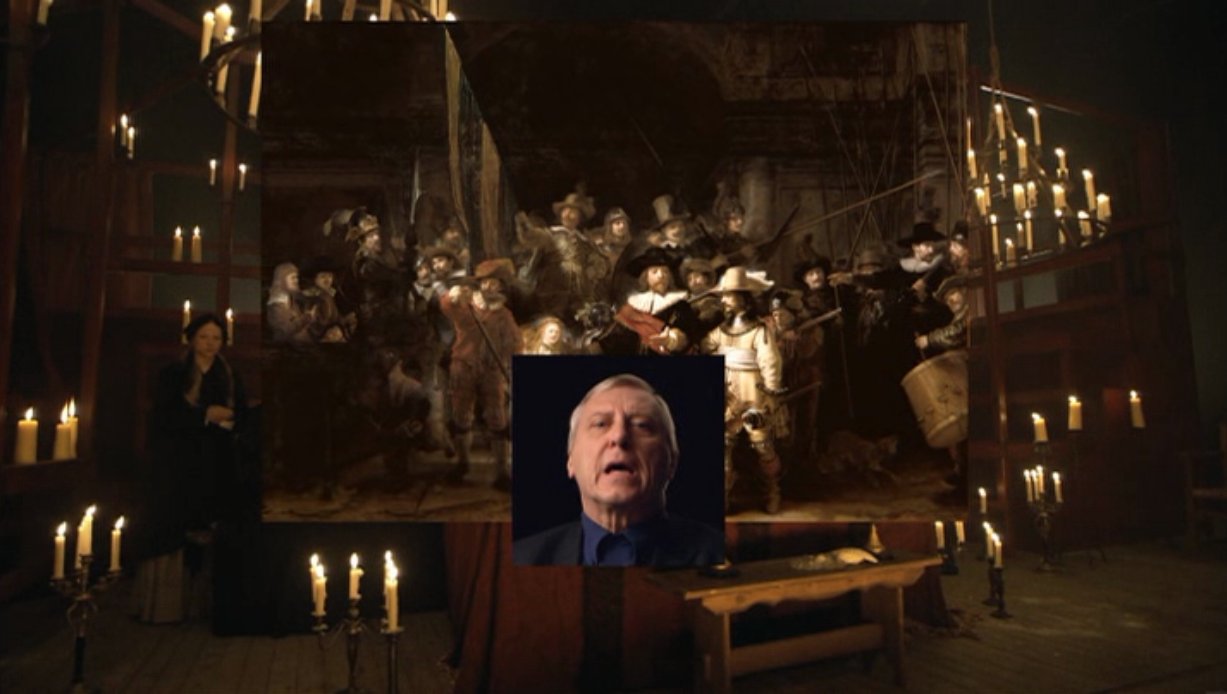
Interwoven within the documentary are scenes from Greenaway's earlier fictional retelling of the same story, Nightwatching. It stars Martin Freeman (who starred in the British Office show and a bunch of other stuff, including The Hitchhiker's Guide to the Galaxy). I found these scenes really strange at first. They seemed very out of place, at least until I found out that they were from an earlier Greenaway film. Then it made sense.
As previously mentioned, Greenaway does employ some visualization efforts to help call out certain features and structures within the painting. Some of the interesting ones are below. The first is one that silhouettes out the main actors in the drama of the painting. Then there's one that numbers all of the participants (you'll have to click on the image to get a good look at that one). There are a few that attempt to visualize the lines of sight of all the characters (only two are looking directly at the audience - this is one of the mysteries that Greenaway explores).
One of the things that interested me about the film was that many of the "mysteries" are probably things that most people would notice if you asked them to stare at the painting for an hour. They don't have the exformation to read the painting correctly, but they'd easily be able to pick out a lot of the most salient features. For instance, it's easy to question why the girl in the painting is so prominent. It's the brightest part of the painting, and your eyes go there almost immediately upon viewing it. If given some time, you can even see that there's another girl behind the first, and her face is obscured (it turns out that Rembrandt painted it this way because the girl had horrible burns on her face and was thus self-conscious about it). I think the grand majority of the mysteries that Greenaway examines would be found if only someone took the time to really study the painting. Of course, I suspect most people don't actually do that sort of thing, so Greenaway does have a point, but still.
Below is the aforementioned "ridiculous getup" that Greenaway puts on at one point. Again, I think this is how he is stressing his own subjective involvement in what we're seeing.
Well, I think that just about wraps up my thoughts on Rembrandt's J'accuse. In closing, I'll give you one of the final shots of the film, which is a sorta reprise of the title screen. It's still cluttered and busy, but somehow not quite as pointless as the title screen.
It was an intriguing movie, I guess. It would be even more interesting if I could hear what other art historians and experts thought about it... Posted by Mark on December 13, 2009 at 08:04 PM .:
Comments (1) |
link
:. ![]()
Sunday, November 01, 2009
18½ Philadelphia Film Festival Recap On Saturday, October 17 I made the trek into the city to watch four films from the 18½ Philadelphia Film Festival. Alas, that comprised the whole of my viewing experience for this festival, but it was a very good day. Here's a quick recap of three of the films:
All in all, it was a very good day and a much better experience than the last few movies I'd seen at the Philly Film Fest... Not sure if that's because it was all in one day or if it was because the films were just better, but whatever the case, I had a lot of fun. Update: I've written a rather long and involved post about the aforementioned Rembrandt's J'accuse... Posted by Mark on November 01, 2009 at 12:53 PM .:
Comments (0) |
link
:. ![]()
Wednesday, October 07, 2009
18½ Philadelphia Film Festival I was pleasantly surprised to learn that Philly is having another festival in the fall. Traditionally, the festival is held in the Spring (and I've attended for the past few years), so I'm not sure if this fall festival will be a permanent change or simply an addendum to the existing festival. Either way, it's an interesting idea and would allow Philadelphia to play films that premiered at other, larger festivals like Cannes, Toronto, and Venice. This year's fall festival is relatively small: 5 days, 37 films. That being said, a number of them caught my eye (alas, only a couple probably qualify as horror movies and are thus suitable for my 6 weeks of Halloween marathon). Amazingly enough, four of my choices fall on one day and are not conflicting, so I'll probably end up seeing more of these fall films than I did in the Spring festival. Here's my schedule:
Posted by Mark on October 07, 2009 at 06:57 PM .:
Comments (0) |
link
:. ![]()
Sunday, April 05, 2009
Philadelphia Film Festival: Playing Columbine A few years ago, student filmmaker Danny Ledonne discovered a computer program called RPG Maker (which provides an easy way to create a video game without having to learn programming) and decided to make a game that would explore issues important to him. As a high school student in Colorado at the time of the Columbine shooting, he found that event to be particularly important in his life. He recognized himself in the shooters and wanted to make a game that explored that concept as well as the idea that video games were themselves responsible for the tragedy. So he made a game called Super Columbine Massacre RPG! where you play Eric Harris and Dylan Klebold and act out the massacre, following events on the day of the shootings and continuing after their suicide into hell (where they fight creatures from the video game Doom). In 2005 he (anonymously) made the game available for free on the internet. He didn't do much in the way of promotion for the game, but it almost immediately started garnering attention due to its controversial subject matter. Many people condemned the game and its creator, but it eventually started to pick up some supporters who mounted a defense. As a way of explaining his actions, Ledonne made a documentary called Playing Columbine in 2007 that covers why and how he created the game, and then springboards to broader discussions on the role of serious video games and art in our society.The film has been making its way through the festival circuit since then, including a the showing I saw yesterday at the PFF. While I wouldn't say that Ledonne is anywhere close to Errol Morris territory, I do think he has crafted an effective exploration of an intensely personal subject. Without knowing much about the game or the movie going in, I suspected that there might be something of a conflict of interests for Ledonne. Was this going to just be an exercise in self-serving defensiveness and bias, or would it be a legitimate exploration of video games, art, and culture? I'm happy to say that Ledonne has succeeded in making a movie that is more than just a defense of his simple game. Of course, the film starts by detailing the controversy surrounding the game and the response to the game. However, the movie wisely strays from the game at almost every opportunity in order to explore broader and more interesting concepts such as the demonization of video games in the media, the value of video games as an artistic medium, censorship, responsibility and the nature of violence and school violence. There is a somewhat cyclical structure to the film, as each segment uses the Super Columbine Massacre RPG! game as a springboard to discuss different ideas and controversies surrounding video games in general. For instance, one segment covers an incident where the game was pulled from the Slamdance Film Festival's Guerrilla Gamemaker Competition by festival director Peter Baxter. As a result, half of the other game developers withdrew their games from consideration and USC pulled its sponsorship of the competition. The details of this particular story are interesting by themselves, but the movie uses this as a jumping-off point to discuss broader ideas of censorship and art. The film is comprised primarily of talking head interviews intersperced with video game and movie clips, but Ledonne has done a great job assembling an appropriate and noteworthy cast of game developers, university professors, media experts, school shooting survivors and even game critics. Some notable names include Ian Bogost (video game professor and designer), Hal Halpin (founder of video game trade organization), Jenova Chen and Kellee Santiago (designers of Kaedrin favorite, Flower), Jack Thompson (attorney and anti-video game activist), and Andrew Lanza (NY State Senator and video game critic). There are lots of other worthy contributers as well, and they mostly have interesting and thought provoking things to say. By necessity, Ledonne himself also appears throughout the film (for example, there are excerpts of interviews and lectures he has done), but you see him as one of many video game designers and experts throughout the film, not as the director (unlike, say, Bowling for Columbine). The movie obviously has its own bias, and the amount of time given to critics is dwarved by proponents, but the film does a good overall job of letting you know that fact. Perhaps it's just my current obsession with video games and art, but I did thoroughly enjoy this film. Unfortunately, I it may be difficult to actually see the film, as there doesn't appear to be any DVD release scheduled and I suspect there are a lot of clearance issues that would need to be worked out. Still, if you get a chance to watch it, I would recommend it. Even if you're not interested in a Columbine game, the movie goes much deeper, exploring interesting and broader topics like censorship and violence in the media. Speaking of which, I'm reminded of this exchange from the Acts of Gord: "We would like a quote for the front page of the newspaper talking about videogame violence, and it's possible impact on society."Heh. I'm still not sure I'll ever play the game, but that isn't because I think there's something wrong about its very existance or anything. Anyway, because of the game, we get a good, thought-provoking movie, which is good enough for me. *** Posted by Mark on April 05, 2009 at 02:48 PM .:
Comments (3) |
link
:. ![]()
Wednesday, April 01, 2009
Philadelphia Film Festival: Recap (part 1) As I've mentioned earlier, this year's festival isn't quite as exciting to me as it has been in previous years, but so far I've had pretty good luck. Here are some quick thoughts on a trio of pretty good movies.
Posted by Mark on April 01, 2009 at 08:13 PM .:
Comments (0) |
link
:. ![]()
Wednesday, March 04, 2009
Danger After Dark The schedule for the Philly Film Festival was announced recently. As with previous years, my favorite part of the festival is sure to be the Danger After Dark series, which is generally filled with all sorts of genre films. However, in flipping through the program guide, it seems that the PFF is significantly reducing the size of the Danger After Dark series. Last year, there were 19 films in the DAD series. This year? 11. I was talking to someone at a screening last year who said that the guy that used to run the series was great, but that he left and the new guy wasn't as good. I guess new guy is still there. Particularly noticeable is a lack of Asian gangster films. Just about everything listed is a horror film. All of that said, looking through the rest of the program, I think I'll be able to find some other films to pick up the slack. Here are the films I'm most looking forward to:
Posted by Mark on March 04, 2009 at 07:59 PM .:
Comments (0) |
link
:. ![]() |
Where am I?
This page contains entries posted to the Kaedrin Weblog in the Philadelphia Film Festival 2009 Category. Inside Weblog Archives Best Entries Fake Webcam email me Archives July 2010 June 2010 May 2010 April 2010 March 2010 February 2010 January 2010 December 2009 November 2009 October 2009 September 2009 August 2009 July 2009 June 2009 May 2009 April 2009 March 2009 February 2009 January 2009 December 2008 November 2008 October 2008 September 2008 August 2008 July 2008 June 2008 May 2008 April 2008 March 2008 February 2008 January 2008 December 2007 November 2007 October 2007 September 2007 August 2007 July 2007 June 2007 May 2007 April 2007 March 2007 February 2007 January 2007 December 2006 November 2006 October 2006 September 2006 August 2006 July 2006 June 2006 May 2006 April 2006 March 2006 February 2006 January 2006 December 2005 November 2005 October 2005 September 2005 August 2005 July 2005 June 2005 May 2005 April 2005 March 2005 February 2005 January 2005 December 2004 November 2004 October 2004 September 2004 August 2004 July 2004 June 2004 May 2004 April 2004 March 2004 February 2004 January 2004 December 2003 November 2003 October 2003 September 2003 August 2003 July 2003 June 2003 May 2003 April 2003 March 2003 February 2003 January 2003 December 2002 November 2002 October 2002 September 2002 August 2002 July 2002 May 2002 April 2002 March 2002 February 2002 January 2002 December 2001 November 2001 October 2001 September 2001 August 2001 July 2001 June 2001 May 2001 April 2001 March 2001 February 2001 January 2001 December 2000 November 2000 October 2000 September 2000 August 2000 July 2000 Categories 12 Days of Christmas 2006 Movie Awards 2007 Movie Awards 2008 Movie Awards 2009 Movie Awards 6 Weeks of Halloween Administration Anime Arts & Letters Atari 2600 Best Entries Commodore 64 Computers & Internet Culture Disgruntled, Freakish Reflections Harry Potter Hitchcock Humor Link Dump Lists Military Movies Music Neal Stephenson NES Philadelphia Film Festival 2006 Philadelphia Film Festival 2008 Philadelphia Film Festival 2009 Philadelphia Film Festival 2010 Politics Science & Technology Science Fiction Security & Intelligence The Dark Tower Uncategorized Video Games Weblogs ![]() |
Copyright © 1999 - 2009 by Mark Ciocco.
|