
By popular request, here is a brief analysis of time travel used in the movie Donnie Darko. As I’ve mentioned before, Donnie Darko is an enigmatic film and I’m not sure it makes total sense. At a very high level everything seems to fit, but when you start to drill down into the details things become less clear.
In the commentary track of the Directors Cut DVD, writer/director Richard Kelly attempts to clarify some of the more mystifying aspects of the film, but he still leaves a lot of wiggle room and ambiguity. He describes the time travel in the film as being driven by a “comic book logic,” which should give you an idea of just how scientifically rigorous the subject is treated in the film (i.e. not very). Time travel is essentially a deus ex machina; it drives the story, but its internal mechanics are unimportant. So this analysis isn’t really intended to be very rigorous either, just a few thoughts and attempts to clarify or at least call out some of the more confusing concepts.
Before I really get into it, I suppose I should mention that what follows contains many SPOILERS, so read on at your own risk. Another thing that might be useful is to go over other less than rigorous time travel theories that have been presented in film and literature. This list isn’t meant to be complete, but these four theories will help in dissecting Donnie Darko. Again, many SPOILERS, especially in the case of lightning (as I’m assuming most people haven’t read it).
- The Terminator: The main timeline is set, and traveling back in time cannot change anything. Indeed, traveling back in time to change the present will sometimes cause the very thing you’re trying to avoid, as happens in The Terminator (for obvious dramatic reasons). This is among the more plausible time travel theories, as it avoids those messy paradoxes. As such, it is one of the more popular theories, used in many other stories (like 12 Monkeys and, funnily enough, Bill & Ted’s Excellent Adventure). A more pretentious name for this is Circular Causation, but I think The Terminator gets the point across…
- Back to the Future: There are, I suppose, many ways to interpret time travel in this movie, but in this theory, there is still only one timeline, but you can change the past (and thus the present). In this theory, it’s possible to go back in time and kill your father (before he had you), and in such a case you will “disappear.” This is also a common theory, but the presence of paradox makes it less plausible. There are probably ways to explain this theory in terms of alternate universes (multiple timelines) as well…
- The End of Eternity: In Isaac Asimov’s novel, a group of people known as Eternals develop time travel and decided to improve upon history by introducing carefully calculated changes in the timeline. There is more to it than that, but the concept of a society using time travel to manipulate history is an important concept that is relevant to DD.
- Lightning: In Dean Koontz’s novel, time travel is only allowed in one direction: to the future. This takes care of the “kill your father” paradox rather neatly. You can, however, change the future. There is a catch though, which is probably more for dramatic effect, but which bears importance in the Donnie Darko discussion – essentially, fate doesn’t like it when you attempt to change something in the future: “Destiny struggles to reassert the pattern that was meant to be.” Not particularly scientific, but interesting and again, relevant to DD.
Donnie Darko sort of contains elements of all four, and since it includes the Back to the Future theory, it also sort of includes a paradox. To start, here is a diagram that will help visualize the time travel present in the film:
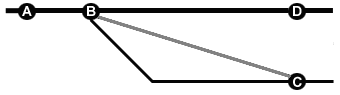
It’s not really to scale, but you get the point. Basically, the main timeline is displayed in the line segment AD (and it is a thicker line, as it is the timeline that is meant to be). BC (the black line) represents the tangent universe, a sort of alternate timeline, and this is where the majority of the film takes place. CB (the grey line) represents the time travel in the film. More details listed below:
- AB – Point A is the start of the film, and the segment AB takes place before the tangent universe begins.
- BC – Point B is the point at which an airplane engine lands on Donnie Darko’s house. It is also the point at which the tangent universe begins. It is unclear as to why or how the tangent universe begins, but in the main timeline Donnie is killed, while in the tangent universe, Donnie is sort of called out of his room by a mysterious force and thus is not killed by the engine. As the movie goes, shortly after point C, the entire universe (I assume this includes the main timeline as well) is destroyed. This implies that tangent universes must be resolved and cannot be allowed to continue. The film references a fictional book which describes the tangent universe thusly:
If a Tangent Universe occurs, it will be highly unstable, sustaining itself for no longer than several weeks.
Eventually it will collapse upon itself, forming a black hole within the Primary Universe capable of destroying all existence.
This particular information is referenced in the Directors Cut, but not in the theatrical cut.
- CB – This segment is represented by the grey line between points C and B. At point C, a jet engine falls off an aircraft and travels back in time, hitting Donnie’s house at point B. I assume that this event is what causes the tangent universe to form in the first place, which is paradoxical – how can the tangent universe exist when it is caused by itself?
- BD – The period immediately following point B is shown in the film, but the rest of the segment is not. It is unclear whether or not the jet engine falls off the plane at point D (which parallels point C) or not. I get the impression that it doesn’t, but if it did, it might help resolve the paradox shown in CB.
Even after all this, there are still many, many, many questions to be answered. There are a few other things we need to establish first.
First, does Donnie have some sort of superpower? Donnie is obviously different from other people. The film doesn’t show any sort of explicit references to his powers, but it is sort of implied by his visits to a psychiatrist and his visions. I suppose the water trails he sees (which show the future path of a person, sometimes including himself) could be an expression of his abilities (as it allows him to see into the future). It’s clear that Donnie made a decision near the end of the movie that he was going to “fix” the universe and allow himself to be killed by the jet engine, but it’s not clear how that happens. Does Donnie actually cause that to happen, or is he just aware of it happening and going along for the ride? There is a sort of messianic theme in the movie, so I’m assuming that Donnie has some sort of power to send himself and/or the jet engine back in time and link the two universes together (and to collapse the tangent universe without destroying all of existence).
Richard Kelly, in explaining his take on the story, indicated that he wanted to communicate that there was some sort of technology at work in the tangent universe, manipulating everyone’s actions, and attempting to set things right. It is unclear what exactly this technology is, how it works, or who is using it, but his point is that someone is orchestrating events in the tangent universe so as to fix the universe (or to allow Donnie the opportunity to fix things). When he mentioned this concept, I immediately thought of Asimov’s Eternals, people who manipulated time and history for the betterment of mankind. In Donnie Darko, perhaps there exists a similar group of people who are tasked with ensuring that tangent universes are closed. Or perhaps, Donnie himself is subconsciously manipulating events to help fix things.
I also thought of Koontz’s Lighting and that infamous line “Destiny struggles to reassert the pattern that was meant to be.” In that scenario, there isn’t really a technology at work, just fate, perhaps augmented by Donnie’s supernatural abilities. Indeed, it could be some sort of combination of these three explanations: Donnie Darko has powers which are augmented by some sort of technology and fate.
What is Frank (the demonic looking bunny), and what role does he play in the story? This is very unclear. He may be a ghost, he may be the result of Donnie’s unconscious awareness of the future, or he may be a projection from the technological puppet-masters.
There are obviously a number of other explanations. What if the timeline actually follows a linear path (i.e. the linear presentation in the movie)? In that scenario, the timeline would go from A to B to C to D, except that B and D are essentially the same point in time (perhaps the main timeline stopped while the tangent universe worked itself out). So the time travel line would occur between CD.
And of course, this doesn’t really take into account all the themes of the film. I suppose I should also note that I’ve been analyzing the Directors Cut, which references a lot more of the fictional book, The Philosophy Of Time Travel by Roberta Sparrow (a character in the film). The Directors Cut gives more information on the guiding forces in the story, and it gives a more sci-fi bend than the theatrical cut, but both cuts are sufficiently ambiguous as to allow multiple interpretations, many of which end up being pretty silly when you drill down into the details, and some don’t make much sense, but in the end that doesn’t really matter all that much because you have to figure it out for yourself…
Yay! Fun fun fun!
I watched Donnie Darko with some friends three years ago. One friend (who is now an ex-friend because he cheated on his wife — the bastard) explained the time travel stuff to me (I believe he got his info from exploring the Donnie Darko website) essentially as one of the possibilities you proposed, that “the timeline would go from A to B to C to D, except that B and D are essentially the same point in time (perhaps the main timeline stopped while the tangent universe worked itself out).”
My ex-friend said that during Frank and Donnie’s first encounter, Frank shows Donnie what will happen if he is absent from his room when the engine falls on his house. The majority of the movie is this “vision”. After seeing this hypothetical future, Donnie decides to sacrifice himself to save the universe.
If such is true, Frank is a part of the deus ex machina, I would think. Perhaps Frank is the technology that Richard Kelly was referring to. I do sense that it is Frank’s role in the movie to be a manipulator.
I lean towards believing that the tangental timeline didn’t actually occur. Oh yes, it would have occurred, but because of Donnie’s actions, it remained a vision only. This almost neatly solves any problems with time-travel paradoxes…except, where did that airplane engine come from?
As to whether Donnie has any superpowers, why not? If there’s going to be a deus ex machina or the influence of an omniscient being/technology (Frank or the Eternals), then I can accept just as easily that Donnie has special abilities.
That’s certainly an interesting interpretation, but as you mention the jet engine does present a bit of a problem to that version. There are a few other minor bits that might present problems too, though they could be more Directors Cut type things. The original cut is certainly more ambigious, so more interpretations are possible with that one…
I think Donnie Definitely has some sort of powers, but the question is to what extent and how does he use them? Not important thematically to the story, but still curious:P
A little blue sky thinking. What if tangent universes aren’t destructive and are forming at every decision node (Quantum theory many worlds). In that is true, there isn’t any time travel as we think of it. When you go back, you are by definition in a tangent universe because that travel is an event node that creates a new tangent universe (a low probability event path). There is also no going back to your starting point since the future you came from is in a different universe.
Thanks for the comment John. Interesting, and certainly more coherent than what is presented in the film. I don’t know that it fits exactly with DD, but I’m sure using such a theory could make for a great story (and perhaps already has!)
This was always the way I wanted to think of the Back to the Future movies, but they had some details which don’t fit…
Nice analysis! The main thing that kept bugging me about the movie was: does Donnie actively go back in time, or is he, as you say, along for the ride.
Re: John’s comment on the quantum many-worlds interpretation, there’s a fairly good book called The Proteus Operation by James P. Hogan that makes use of it very well. The book focuses on people from two different alternate futures manipulating the events leading up to World War II to create our own history.
Oh, one nitpick: I don’t think deus ex machina is quite the phrase you’re looking for. It generally refers to something that shows up *completely* out of the blue to resolve a story. “Surprise, I poisoned the wine for the ceremonial toast before the big duel, so the vastly underpowered heroes won’t have to fight the villains.” Certainly time travel can be used as a deus ex machina, and the “cosmic reset switch” is often used that way, but in Donnie Darko — or at least in the director’s cut (I haven’t seen the theatrical release yet) — it’s clear fairly early on that time travel is involved somehow.
Thanks for the comments Kelson. I think I’ve heard of that book before, but I couldn’t remember the name or author. Thanks! I’ll put it in the queue, which means I’ll get to it sometime in the next decade:P
PS. Due to the proliferation of comment spamming, I’ve taken various measures to ensure that said spam does not get through. One such measure is to force moderation on comments to older entries, and this one qualified. Sorry for any confusion…